











 MIRAI TOKYO concierge team

Meguro and Gotanda sit next to each other on the southern side of the JR Yamanote Line, yet they make distinctly different hotel bases. Meguro suits travelers who want a calmer neighborhood feel and a four-line station. Gotanda is more openly practical: a residential and business district with city hotels, compact business properties and rooms designed for longer stays. If your Tokyo plans may include private outcall, the better choice is not the area with the louder nightlife reputation. It is the area whose transport, hotel style and evening rhythm fit the rest of your stay.
Table of Contents
- Meguro vs. Gotanda at a Glance
- Choose Meguro for a Calmer, Multi-Line Stay
- Choose Gotanda for Business Convenience and More Hotel Formats
- Match the Hotel Format to the Kind of Stay You Want
- The Current Transport Fee Does Not Decide Between Them
- Two Distinct Hotel Contexts in Gotanda
- Which Base Fits Your Trip?
- After You Choose the Hotel, Confirm the Rules
- FAQ
- Summary
Meguro vs. Gotanda at a Glance
Both areas let you stay on the Yamanote Line without making Shinjuku or Shibuya the center of every evening. The difference is what each station adds around that loop line. Meguro opens into several quieter residential and commercial directions. Gotanda works as a compact business base with a wider range of conventional hotel formats and a separate adult-nightlife context nearby.
| Comparison | Meguro | Gotanda |
|---|---|---|
| Overall feel | Composed commercial and residential atmosphere, with greenery and cultural spaces in the wider area | Residential and business district with an active station center and a more visible late-night side |
| Rail connections | JR Yamanote, Tokyu Meguro, Tokyo Metro Namboku and Toei Mita lines | JR Yamanote, Toei Asakusa and Tokyu Ikegami lines |
| Hotel pattern | Station-adjacent compact or design-led stays, plus quieter residential-area options beyond the station | City hotels, business hotels and extended-stay rooms clustered around a business hub |
| Evening context | Better suited to guests who do not need a nightlife district outside the door | Regular hotel stays and a separate love-hotel district exist in the same broader area |
| Current MIRAI TOKYO transport band | ¥2,000 for a Meguro Ward address; some Meguro Station addresses are in Shinagawa, also currently ¥2,000 | ¥2,000 for a Shinagawa Ward address |
| Best fit | Calmer base, multiple rail directions, an evening centered on the hotel area | Business trip, longer stay and practical conventional hotel choice |

These patterns describe ways to stay, not permission for outcall. No hotel named below is presented as a MIRAI TOKYO partner or a confirmed dispatch address.
Choose Meguro for a Calmer, Multi-Line Stay
Meguro is the stronger choice when the hotel should feel separate from the evening rather than part of it. Around the station, everyday shopping streets give way to residential neighborhoods, while the wider Meguro side reaches toward the Meguro River and areas where nature and cultural spaces soften the dense-city atmosphere. It is still central Tokyo, not a silent retreat, but the rhythm is less dominated by a single entertainment district.
The transport advantage is broader than the Yamanote Line. Meguro Station also connects to the Tokyu Meguro Line, Tokyo Metro Namboku Line and Toei Mita Line. That makes it useful when your schedule moves between different parts of central and southern Tokyo. A traveler may choose Meguro not because it is the closest point to one attraction, but because several directions remain easy without returning to a mega-hub every time.
There is one geographical detail worth knowing before you compare hotels: Meguro Station itself is in Shinagawa City. Cross toward the west and southwest, and a hotel may instead have a Meguro City address. This is not merely trivia. Two properties described as “near Meguro Station” can sit in different wards, so the formal address is more reliable than the marketing area name.

The accommodation mix reflects that geography. MEGUROHOLIC HOTEL, a three-minute walk from the west exit, offers compact room types among its range of rooms. Farther into Meguro City, Tokyu Stay Meguro Yutenji pairs a quieter residential setting with laundry and kitchenette facilities in selected rooms. Together they illustrate a station-adjacent stay and a residential, longer-stay option; neither example establishes an outside-visitor policy.
Choose Meguro if you expect to spend the day moving around Tokyo, then want to return somewhere that does not demand another round of nightlife navigation. It also fits a guest who values access to several rail networks more than having the largest hotel selection within a few blocks.
Choose Gotanda for Business Convenience and More Hotel Formats
Gotanda feels more functional at first glance. It is a residential and business district, with offices, restaurants and conventional hotels concentrated around a station that serves commuters as much as visitors. The separate love-hotel cluster is one part of the broader district, not a description of every street or hotel. That distinction lets a traveler use Gotanda as a practical business base without treating its nightlife context as the purpose of the stay.
The station combines the JR Yamanote Line with the Toei Asakusa Line and Tokyu Ikegami Line. The Asakusa Line is useful for plans on the east side of central Tokyo and for connections in the direction of Haneda. The Ikegami Line reaches quieter residential districts to the south. Gotanda therefore suits a stay shaped by business appointments or repeat journeys, not only a first-time sightseeing circuit.
Its hotel supply is visibly varied. Mitsui Garden Hotel Gotanda illustrates the upper city-hotel end, with a sky lobby, restaurant and large public bath close to the station. Tokyu Stay Gotanda illustrates the extended-stay end, with in-room laundry equipment and microwaves, plus kitchenettes in selected rooms. Around them are more compact business hotels designed for a straightforward room-and-station routine.

That range makes Gotanda easier to match to a specific trip. A short business visit may call for a room close to the station. A week in Tokyo may make laundry or a kitchenette more valuable than a large lobby. A guest who prefers city-hotel amenities may choose a different property again. The key distinction is between what makes a room useful for your stay and whether the property allows an outside visitor. One does not prove the other.
Match the Hotel Format to the Kind of Stay You Want
The most useful comparison is not “luxury versus cheap.” It is the way the room and building support the hours you will actually spend there. Both Meguro and Gotanda include more than one accommodation type, and price alone does not tell you which will feel easier at the end of the day.
| Hotel format | What it may suit | What still needs checking |
|---|---|---|
| Compact station hotel | Short stay, late return, minimal walking with luggage | Reception hours, lobby or security gates, registered-guest and visitor rules |
| City hotel | More amenities, a fuller hotel experience, time spent on the property | Visitor registration, reception procedure and key-controlled elevator access |
| Business hotel | Meetings, efficient check-in, a predictable room-and-station routine | Front-desk procedure, non-registered visitor rules and room size |
| Extended-stay hotel or residence-style room | Multi-night trip, laundry, kitchenette and a more residential rhythm | Building access, reception hours, security gates and rules for non-registered visitors |
No format is automatically included or excluded. A business hotel or extended-stay property may remain a candidate when its rules allow the intended visit and MIRAI TOKYO can accommodate the exact property and time. Hotel websites can confirm address, room size, equipment and station access; if the visitor policy is unclear, ask the property directly before sending the exact hotel name and address to the MIRAI TOKYO concierge.
The Current Transport Fee Does Not Decide Between Them
MIRAI TOKYO’s current transportation table places both Shinagawa and Meguro in the ¥2,000 band, so the usual Meguro-versus-Gotanda decision is not a fee calculation. The amount is separate from course and nomination fees and may change; use the hotel’s formal address and confirm the current figure on the pricing page before booking.
Two Distinct Hotel Contexts in Gotanda
Gotanda appears in two kinds of Tokyo hotel search. One concerns a conventional stay: city hotels, business properties and extended-stay rooms around a working station district. The other concerns Gotanda’s established love-hotel area. They occupy the same broader geography but answer different accommodation questions.
For a conventional hotel base, compare location, room, transport and the property’s visitor policy. If a love hotel is the accommodation type you specifically want, district choice and that format’s rules become the relevant questions. In either case, confirm the property’s rules and whether MIRAI TOKYO can accommodate the exact property and time.
The separate guide below covers Gotanda as one of Tokyo’s love-hotel districts. This article does not repeat its facility-selection or check-in context.
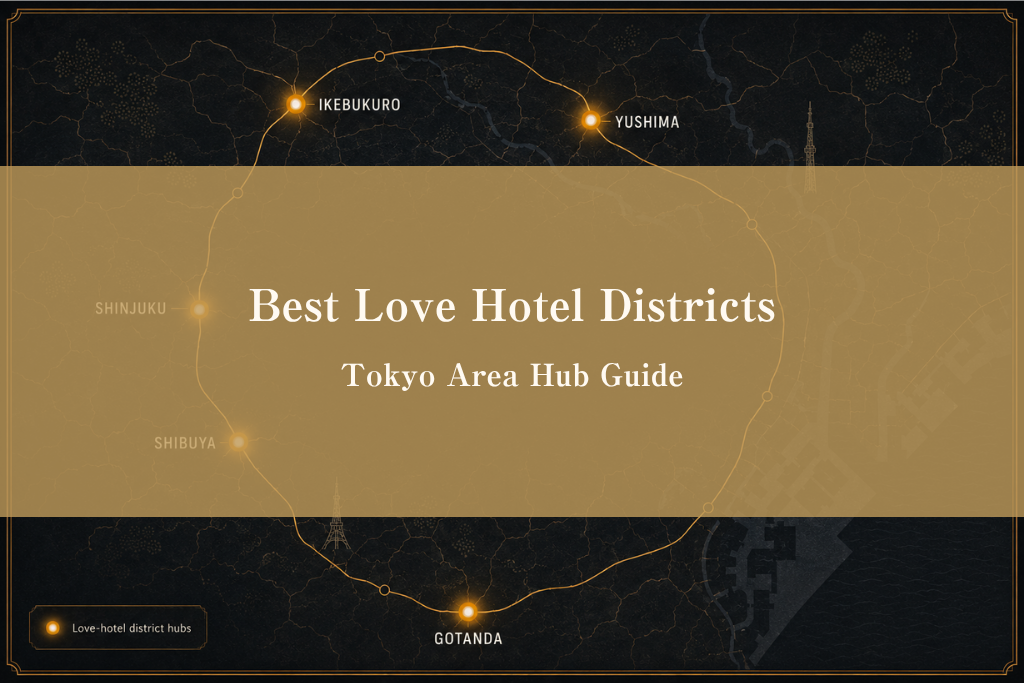
Best Love Hotel Districts in Tokyo | MIRAI TOKYO
Tokyo love-hotel districts explained—Ikebukuro, Shinjuku, Shibuya, Gotanda, Yushima—area guide for foreign guests choosing where to go.
Which Base Fits Your Trip?
Choose Meguro when the hotel should feel calmer than the rest of the itinerary. It is the stronger fit if you value four rail lines, want a less nightlife-led station environment, or plan to move between central Tokyo and residential areas before returning to a quieter base. It also makes sense when the hotel itself is a supporting part of the trip rather than the main event.
Choose Gotanda when practical hotel choice matters more. It fits meetings, repeat journeys and longer stays particularly well because the area combines business access with city, compact and extended-stay hotel formats. The Asakusa and Ikegami lines add useful directions beyond the Yamanote loop.
Choose a love hotel only when that accommodation type is your specific goal. That is not the same decision as selecting a Gotanda business hotel for a five-night trip. Keep the two plans separate, then use the dedicated district guide if the love-hotel question is relevant.
If you have already booked, there is no reason to change hotels merely because the other area sounds better in one category. The useful next step is to check your property’s actual rules and share the exact address. For a broader explanation of how location, timing and hotel information affect dispatch across Tokyo, use the coverage guide.
Tokyo Outcall Coverage & Areas | MIRAI TOKYO
Where can outcall reach in Tokyo? Travel time, area fees, hotel rules, and how to ask for coverage and arrival windows with clarity.
After You Choose the Hotel, Confirm the Rules
A good hotel choice creates the setting; it does not complete an outcall booking. Before a companion is dispatched, confirm three separate things:
-
Check the property’s current visitor policy
Look for official rules on registered guests, outside visitors, reception procedures and room access. If the policy is not published clearly, contact the property rather than relying on an old hotel list.
-
Share the exact hotel and address
Tell the MIRAI TOKYO concierge the property name, formal address, preferred date and preferred time. “Meguro” or “Gotanda” alone is not enough to confirm the setting.
-
Confirm availability, fees and arrival before finalizing
Companion availability, timing, course, nomination fee if applicable, transportation and the proposed arrival method should be clear before you confirm.
MIRAI TOKYO recommends making a request two to three hours in advance. Same-day requests may be possible when schedules allow, but neither area guarantees immediate availability. The official booking guide explains the inquiry, selection, confirmation and arrival flow.
FAQ
Pick the Hotel Base That Matches the Whole Stay
Meguro and Gotanda are neighboring Yamanote stations, not interchangeable hotel districts. Meguro favors a calmer, multi-line stay; Gotanda favors business access, varied conventional hotel formats and longer visits. Choose the setting that supports the rest of your trip, then treat the property’s visitor policy as a separate confirmation.
Plan the Hotel First, Then Confirm the Booking
Use the booking guide to send MIRAI TOKYO the exact property, address and preferred time, then review the current fee before confirming.
This content is for informational purposes only and does not constitute legal advice. Hotel examples do not indicate partnership, dispatch history or permission for outside visitors. Property rules, pricing, availability and service coverage may change.