











 MIRAI TOKYO concierge team
“Happy ending massage” is an English-language slang term with a specific history. One of the earliest widely cited print examples appears in a 1999 Weekend Australian article, and the phrase became a common Western stereotype for Asian massage parlors through the 2000s. When that search hits Tokyo, it does not land on a single service type. It lands on at least five—regular massage, men’s esthetic, adult massage listings, delivery health (deriheru), and soapland mat play—each with very different legal standing, service design, and risk profile. This guide explains what the term usually refers to in Western slang, what appears in Tokyo search results, where premium hotel-based outcall operators sit within that landscape, and why MIRAI TOKYO should not be confused with the phrase itself.
Table of Contents
Where “Happy Ending” Came From
One of the earliest widely cited print examples of “happy ending” as massage-parlor slang appears in a 1999 article in The Weekend Australian describing a parlor that advertised “a guaranteed ‘happy ending.'” From there the term spread through the English-speaking internet of the 2000s, attaching itself specifically to the stereotype of Asian massage parlors and late-night Bangkok storefronts. By the mid-2010s, Dictionary.com and other mainstream slang references had cataloged it.
The numbers tell the scale. In the United States, PIX11’s “Human Pipeline” investigation cited NYPD Human Trafficking Unit estimates of roughly 9,000 illicit massage businesses nationally, with national industry revenue estimated in the billion-dollar range across the 2010s. Police raids and prosecutions have been a regular news cycle since the mid-2000s. The term is recognizable in English precisely because it was a recurring feature of the US urban landscape for two decades.
What the term itself implies in its common usage: a standard massage followed by a sexual act—typically a manual finish, sometimes oral. The phrase exists because it let advertisers signal the service without using prostitution-adjacent vocabulary directly. In the jurisdictions where it arose, the act is usually illegal, and the phrase operated as an open secret rather than a legal category.
Tokyo is a different environment. The English slang traveled; the service category did not translate cleanly.
Five Categories That Surface in the Same Tokyo Search
Run the phrase “happy ending massage Tokyo” and the results mix at least five categories that operate under different rules. Understanding which result belongs to which category is the core of safely navigating Tokyo’s adult-adjacent marketplace.
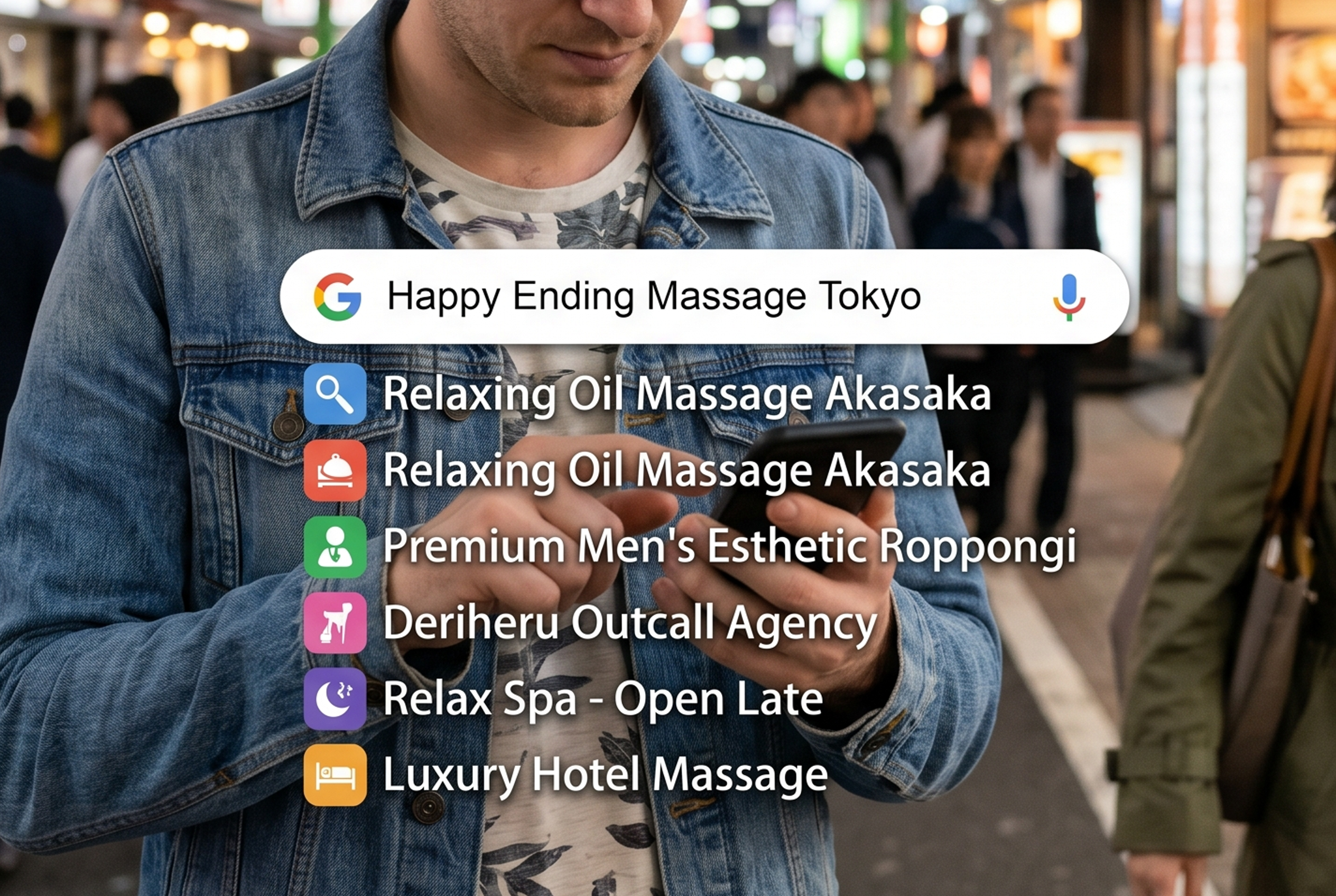
1. Regular massage (shiatsu, Thai, relaxation)
Licensed bodywork providers—shiatsu, Thai, oil massage, integrative relaxation chains (Rilaku, Re.Ra.Ku, etc.). Zero sexual content. Listings usually make this explicit (“authentic,” “legal,” “clothes on”). Areas like Kabukicho include legitimate options (Thermae-Yu, Asian Feeling, and others) alongside much less legitimate storefronts.
2. Men’s esthetic (メンズエステ)
A relaxation-and-esthetic category often marketed as a non-sexual service rather than an adult-business service. Many operators in this segment position themselves without an adult-business notification in their stated business model, and industry norms often emphasize “three prohibitions” such as no undressing, no oral, and no touching of the male genital area. Typical rates run ¥10,000–¥15,000 for 60 minutes, ¥14,000–¥20,000 for 90 minutes, with designation fees of ¥1,000–¥2,000 and optional services of ¥1,000–¥5,000. Once actual services cross into sexual-service territory, legal risk rises sharply; the June 28, 2025 amendment to the Amusement Business Act significantly strengthened penalties for unlicensed operation and related violations, including corporate fines of up to ¥300 million in certain cases.
3. Adult massage listings (often unlicensed)
Listings using “sensual massage,” “adult massage,” “body-to-body,” or “happy ending” directly. Many are unlicensed operations that move between addresses, and a meaningful share of the Kabukicho-area storefronts in this category are targets of ongoing police crackdowns. This is the category that is usually meant when Tokyo-based tourists end up with bottakuri (inflated-bill) or ATM-escort experiences. We’ll come back to this category in the next section.
4. Delivery health (deriheru)
Licensed dispatch-type adult service under Japan’s Amusement Business Act—non-storefront category. Session content centers on adult companionship in a hotel or residence. “Massage” is sometimes in the marketing vocabulary, but this is fundamentally an outcall product, not a massage product.
5. Soapland mat play (マット嬢 / マットプレイ)
The core offering at soaplands—bathing and mat-based service. Operates under the bath-business framing that has persisted since the 1956 Anti-Prostitution Act. Many establishments in Yoshiwara and equivalent districts do not accept non-Japanese-speaking customers, and walk-in accessibility for foreign visitors is highly constrained. English-language framings of this experience sometimes map to the “happy ending” idea imperfectly—it isn’t the same category, and it isn’t marketed that way in Japanese.
Quick comparison
- Where: Regular massage = public storefronts. Men’s esthetic = private rooms. Adult listings = unlicensed or gray-area storefronts. Deriheru = dispatch to your hotel. Soapland = bathhouse-district storefronts.
- Legal framing: Regular = licensed bodywork. Men’s esthetic = relaxation-category (non-adult). Adult listings = often unlicensed. Deriheru = adult notification. Soapland = bath-business framing.
- Foreign-friendly: Regular = yes. Men’s esthetic = varies, Japanese language often needed. Adult listings = not recommended. Deriheru = varies; premium outcall operators are explicitly built for foreign guests. Soapland = largely inaccessible without Japanese.
- “Happy ending” as the listed service: Mostly absent from regular and premium; appears loosely in the adult listings category, where it is also the highest-risk category.
Known Risk Patterns Around English Ads in Kabukicho
Some of the English-language “happy ending” and related advertising foreign visitors encounter in Tokyo is found in Kabukicho, Shinjuku’s entertainment district. In some reported cases, the advertised service differs from what is actually provided, and public authorities have issued warnings about specific patterns. Not every English-language listing in Kabukicho fits these patterns, but the warning signs are worth knowing.
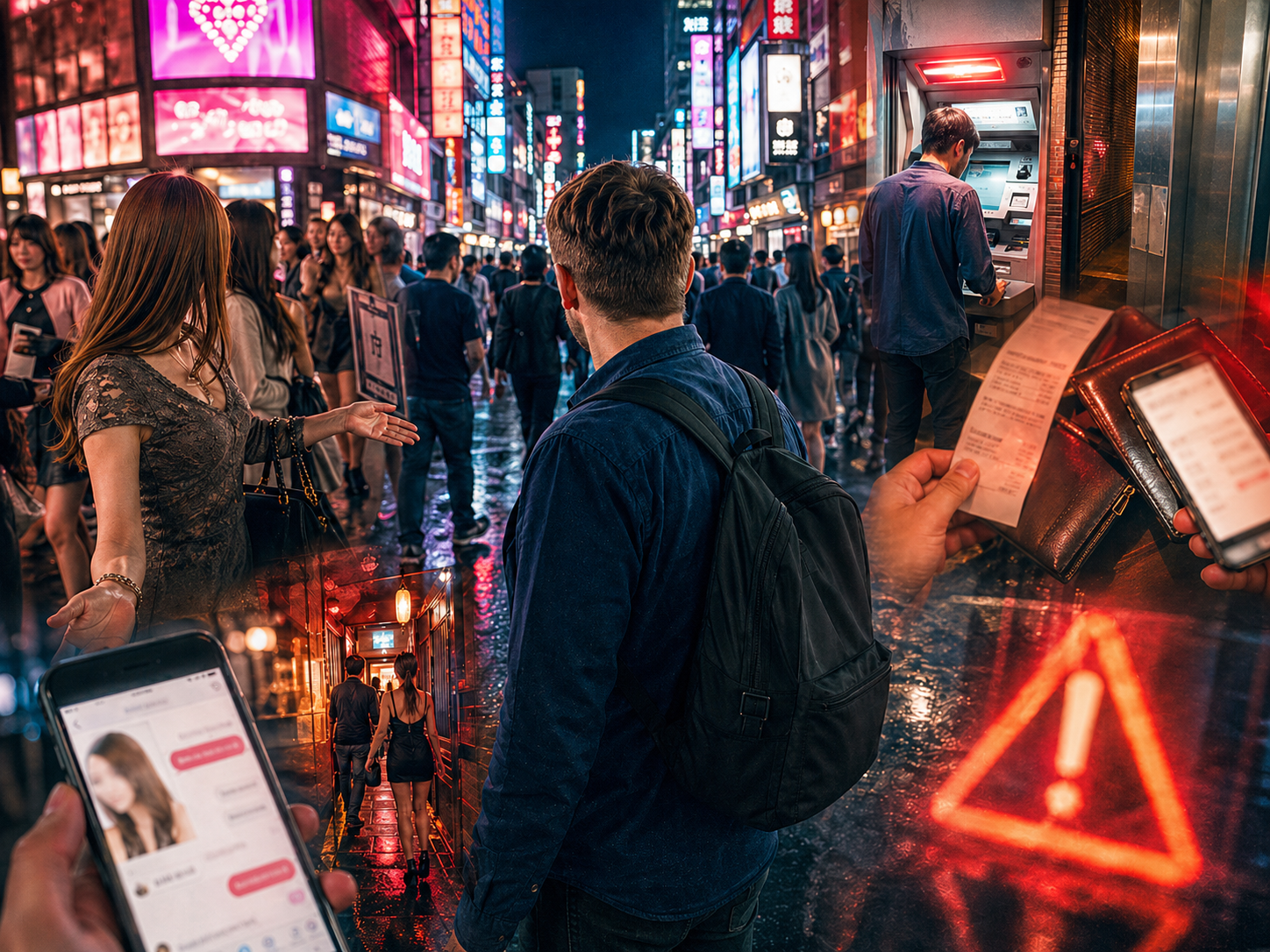
Street touts (kyakuhiki)
Street solicitation of customers—kyakuhiki—is prohibited under several local Tokyo ordinances. Enforcement varies, and visitors to Kabukicho may encounter touts using opening lines like “English OK,” “cheap bar,” or “nice massage.” In some cases, pricing inside the establishment differs significantly from what was implied outside.
Bottakuri bars and ATM escorts
“Bottakuri” refers to overcharge practices that have been reported as a tourist-safety concern: higher-than-advertised prices appearing on the final bill, and in some cases pressure to withdraw cash from a nearby ATM. Stars and Stripes reported on Tokyo police stepping up warnings about rip-off bar scams targeting foreigners, and the US Department of State separately warns that some victims in Tokyo nightlife districts have reported being forced to take money out of ATMs to settle large bar tabs. Tokyo Metropolitan Police English-language warnings cover this same risk category.
Honey trap and dating-app schemes
A related pattern sometimes reported in Japanese media: a friendly conversation (in some cases initiated through dating apps) leading to a private room or rental space, followed by cash demands or disappearance after payment. Unseen Japan and Tokyo Weekender covered specific cases (the so-called “Yuri” and “Lila” patterns) in 2024–2025, with reports noting foreign tourists as frequent targets.
Unlicensed massage parlor enforcement
Tokyo Metropolitan Police have conducted operations against unlicensed massage parlors in Kabukicho and adjacent areas at various points; public reporting notes that such establishments sometimes advertise in English under “happy ending” or “sensual massage” vocabulary. From the customer side, a risk in this scenario is being present during an enforcement action; English-language listings using these terms are worth evaluating carefully before visiting.
What official sources say
The Tokyo Metropolitan Police Department’s English-language crime prevention pages explicitly cover nightlife overcharge, street tout, and spiked-drink patterns. The US Department of State’s Japan Travel Advisory mentions the same. These are the two authorities most directly relevant to a foreign visitor, and both address this category of risk in public documents.
Cultural and Legal Gaps Between US/UK and Japan
Expectations traveling from the US, UK, or Australia into Tokyo break in specific ways. The “happy ending” service model that exists in those markets does not translate cleanly.
The legal framing is different
In most US jurisdictions, “happy ending” lives in a direct illegal-prostitution category; the business relies on staying below enforcement thresholds. In Japan, the adjacent spaces (men’s esthetic, deriheru, soapland) are built around the Anti-Prostitution Act’s narrow definition of prostitution, which leaves a wide space around non-intercourse services. The Western model doesn’t have a clean analogue here.
The booking model is different
US massage parlors offering this service generally operate walk-in. Tokyo’s notified adult-service providers operate primarily on a booking basis (phone, web, messaging app). Walk-in storefronts in nightlife districts that aggressively target foreign visitors with English-only signage are worth evaluating carefully—especially if the basics (published pricing, official website, verifiable operator identity) are missing.
The recourse is different
A traveler who runs into trouble in Kabukicho may have limited practical recourse, especially when language barriers, unclear evidence, or informal bookings make documentation difficult. Legitimate operators, by contrast, have published identities, fixed business hours, and cancellation and complaint policies. The structural gap is significant.
What is Delivery Health (Deriheru) in Tokyo? The Risks to Know, and the Safer, Professional Alternat
Learn what “Delivery Health (Deriheru)” in Tokyo really means, the hidden risks around quality, hygiene, privacy and pricing, and how to choose a safer, professional outcall alternative as an international traveler.
A Different Category: Hotel-Based Premium Outcall
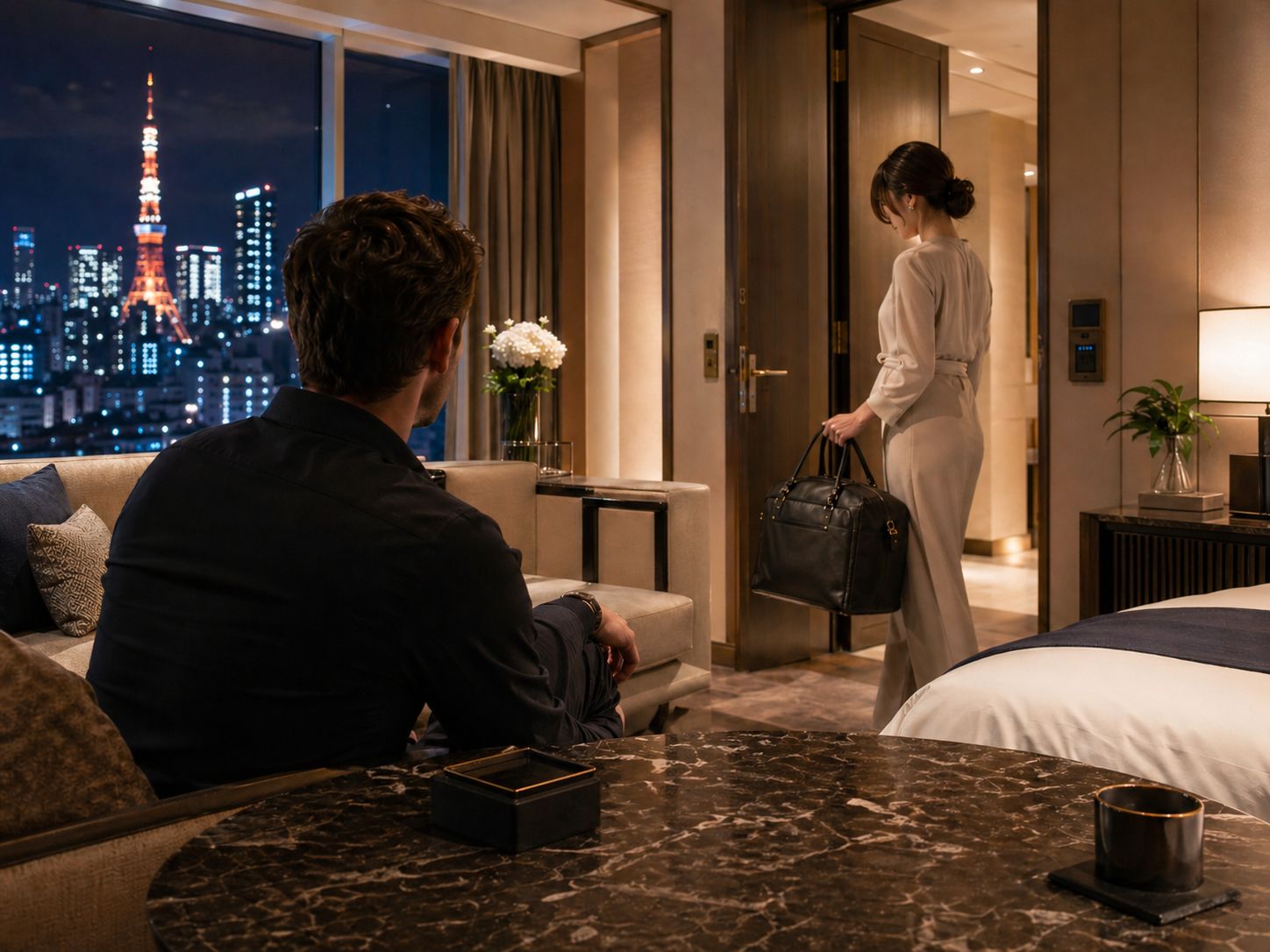
MIRAI TOKYO does not fit the “happy ending massage” category, and it does not advertise as one. It is hotel-based premium companion outcall, operating on the non-storefront adult-service side of Tokyo’s market rather than as a walk-in massage listing. The distinction matters for anyone arriving at this guide through a massage-related search.
What that difference looks like in practice:
- Explicit business identity: Named company, physical office (Roppongi), published rules page, published pricing page.
- Pricing on record: Rank-based course fees (Silver ¥37,000 through Diamond ¥170,000 depending on rank and duration), Photo Selection ¥2,000, Repeat Request ¥5,000, transportation free within Minato Ward. No “from ¥X” ambiguity.
- English support across all channels: LINE, WhatsApp, WeChat, Instagram, KakaoTalk, web form. All staffed in English.
- Hotel delivery: The companion comes to your hotel room at a central Tokyo luxury property. No walk-in storefront, no kyakuhiki, no “English OK” sign.
- Explicit house rules: No minors, no full service, no photography, no drugs, no intoxication, no STIs, no violence, no multiple persons. Published publicly on the How to Use page.
If the reason you searched “happy ending massage Tokyo” was because you wanted a relaxed, intimate private experience at your hotel—without navigating Kabukicho’s riskier storefronts—hotel-based premium outcall is one of the adjacent service categories built around that intent. It is not the same thing, and MIRAI TOKYO does not claim to be. But it is the transparent, hotel-based alternative this search intent often points toward.
Transparent Pricing & Rates - 3 Tiers | MIRAI TOKYO
Transparent pricing for Tokyo luxury escort service: Silver (¥37,000-¥85,000), Gold (¥45,000-¥105,000), Diamond (¥70,000-¥170,000). Time-based sessions from 60-180 minutes. No hidden fees. Free transportation within Roppongi area. English payment assistance available.
FAQ
A Different Category from Walk-In Nightlife Storefronts
MIRAI TOKYO is hotel-based premium companion outcall in central Tokyo. Published identity, published pricing, full English support, companions delivered to luxury hotels. Not a walk-in massage listing, and not marketed as “happy ending massage”; transparency is a core part of how it operates.
 How to Book
Last Updated: 2026-04-25
This content is for informational purposes only. It describes the cultural and commercial context of a Western slang term as it appears in Tokyo search results and references public safety warnings issued by Japanese and US authorities. It does not endorse any service category; individual travelers should verify current regulations, operator identity, and local conditions before engaging any provider.