











 MIRAI TOKYO concierge team
You grew up—or spent enough late nights—on Key’s visual novels, Type-Moon’s routes, Illusion’s character creators, or the rotating catalog of ero-anime. That world has its own logic: stat-building, true endings, harem routes, characters who exist to be pursued. The question “can any of this translate to a real night in Tokyo?” is honest and worth answering honestly. The short version: theme, look, and mood travel. Route structure, character reproduction, and enforced scripts do not. This guide unpacks why the translation breaks where it breaks, which tropes from that world map to real imekura scenarios and real cosplay outcall, and how to describe a fantasy to a Tokyo concierge in a way that actually matches you with a real companion.
Table of Contents
- What Western Fans Bring from Eroge and Ero-Anime
- Structural Gaps Between Game Fantasy and Tokyo Reality
- “Weeaboo Reality Check” Without the Condescension
- Imekura’s Classic Scenario Catalog
- Cosplay Outcall vs. Premium Outcall
- Turning a Game Fantasy into a Booking Request
- How MIRAI TOKYO Handles Theme Conversations
- FAQ
- Summary
What Western Fans Bring from Eroge and Ero-Anime
The baseline context—what Western fans actually carry in their heads when they search “hentai games tokyo”—is a collection of genre shapes and game mechanics built up over decades. A short tour.
Plot-heavy visual novels
Studios like Key built a lineage of visual novels—Kanon, AIR, CLANNAD among the best-known—that paired emotional, long-form storytelling with a small amount of adult content and showed plot-heavy eroge could stand commercially alongside purely pornographic works. Their narrative conventions still color how Western fans imagine Japan’s adult-game landscape today.
The route structure
Story-heavy eroge and visual novels—Type-Moon’s Tsukihime and Fate/stay night are probably the most widely recognized examples in Western fandom—codified a recognizable shape: a shared prologue, branching decisions, multiple heroines with their own storylines, and a canonical “True End” that often requires completing other endings first. This route discipline is a game-design phenomenon—an architecture that works on a screen but does not translate directly to a real-world session.
The character-creator fantasy
Illusion’s Honey Select and Artificial Academy, and adjacent titles, made sliders-and-customization a central part of the adult-game experience—players sculpting characters in near-infinite combinations, posing them, photographing them. That expectation (“if I can imagine it, a Japanese studio has probably built a tool for it”) still colors Western ideas about what Japan’s adult industry offers offline, even as Illusion wound down and successor studios continue the lineage.
Genre tags and trope vocabularies
Attached to all of this is a large, fragmented tag vocabulary: vanilla, NTR/netorare, netori, futanari, yuri, yaoi, tsundere, kuudere, yandere, and several less-printable subgenres. These tags let Western fans filter content efficiently on doujin sites and streaming aggregators; they describe narrative configurations, not consent-based in-person situations.
Structural Gaps Between Game Fantasy and Tokyo Reality
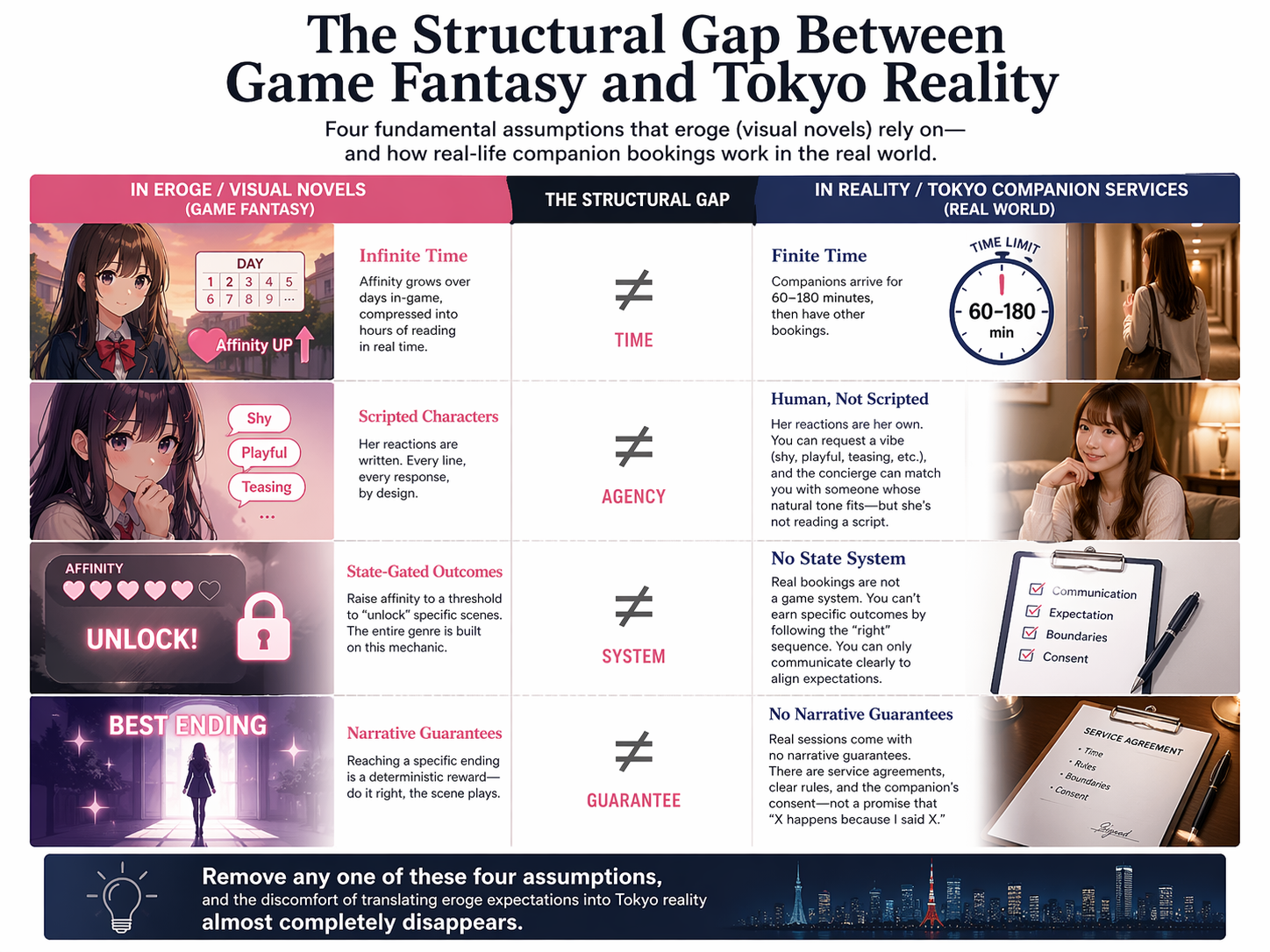
Eroge mechanics assume four conditions that simply do not apply to a real companion booking.
Infinite time
In a visual novel, an affection stat can be grown over days of in-game time spread across hours of real-time reading. In a real booking, the companion has arrived for 60 to 180 minutes and then has other bookings scheduled. Emotional arcs that assume a long-run investment don’t fit inside that container.
Scripted character
A heroine’s reactions in an eroge are authored. A human companion’s reactions in a hotel room are her own. You can describe a preferred personality (“shy,” “playful,” “teasing”), and the concierge can match a companion whose natural register includes that tone—but the companion is not running a script. She is improvising inside her own judgment, which is precisely what you are paying for.
Stat-controlled outcomes
Raising affection to a threshold to “unlock” a scene is the mechanic the entire eroge genre rests on. Real booking is not a stat system. You cannot earn a specific outcome by executing the right sequence of steps. What you can do is communicate clearly so both sides have a shared expectation.
Narrative guarantees
Reaching a specific ending in a VN is a deterministic achievement—you did it right, so the scene plays. In a real session, there are no narrative guarantees. There is a service agreement, there are explicit rules, and there is the companion’s consent. Expecting “guaranteed outcome X because I said X” is the most common failure mode.
Drop any of these four assumptions and most of the discomfort around translating “hentai game expectations” to Tokyo reality evaporates.
“Weeaboo Reality Check” Without the Condescension
The term “weeaboo” is thrown around a lot in English-speaking anime communities, usually as a dig at fans who bring anime assumptions to real Japan in awkward ways. The useful version of the reality check is not the condescending one; it is the one that takes the fantasy seriously and asks “which parts actually come with you into a hotel room, and which parts stay on the screen.”
Recurring mistakes that genuinely go wrong in Tokyo:
- Naming a specific character and expecting the companion to play that character in full. Even operators that tolerate the framing find this produces worse outcomes than a good mood-and-look match.
- Framing a request using genre tags (“I want NTR,” “can you do a netorare scenario”). Genre tags describe stories; they don’t describe consent-based sessions. The concierge has no useful way to act on them.
- Handing over written scripts. Reputable companions decline pre-written scenes, and attempts to enforce them end sessions.
- Expecting age ambiguity around “schoolgirl” or “younger” looks. All companions are adults. The marketing aesthetic of school-uniform cosplay does not change that, and legitimate operators are explicit about the line.
None of this is a “stop liking eroge” correction. It is the narrow set of translation failures that create bad bookings. Skip them and the rest of the fantasy translates fine.
Imekura’s Classic Scenario Catalog
The business format in Japan that most directly answers “scenario-based play” is the image club (イメージクラブ / imekura), classified under the Amusement Business Act as a storefront sex-entertainment business. Imekura specializes in costume-and-scenario play with purpose-built rooms, and the standard scenario catalog reads almost exactly like the trope list from hentai games.
- Classroom (学園): A classroom-styled private room with a school-uniform-inspired look. All companions are adults; the scenario is the stylized after-hours fantasy, not age ambiguity.
- Office / secretary / boss after hours: OL (office lady) costume, stylized office setting, the classic workplace dynamic.
- Train / public-space scenarios (痴漢 play): A staple of imekura scenario vocabulary. In the consent-based form actual imekura offers, the scenario is a roleplay within agreed limits.
- Nurse / exam room: Nurse costume, exam-room setting, the classic nurse-patient scene.
- Maid / household: Maid outfit, domestic roleplay elements.
- Bunny girl: The long-standing Japanese-adult-industry staple. Costume plus themed session.
- Night visit (夜這い): Quiet, low-light, arrived-while-sleeping-style mood. Historically a folk-culture reference that became a scenario category.
Imekura has its own grammar: the scenarios are stylized, the costumes are part of the product, and the companions are trained for the format. A hotel-based premium outcall cannot replicate the purpose-built rooms, but it can absolutely carry the scenario mood—”classroom atmosphere with school-uniform-inspired look,” “OL after-hours setting,” “quiet night-visit vibe”—into a hotel suite. That is where the eroge catalog realistically touches Tokyo reality.
Cosplay Outcall vs. Premium Outcall
Two related but distinct offerings foreign guests often confuse:
- Cosplay outcall (non-storefront): A deriheru-category dispatch where companions arrive at your hotel room in costume. Costume variety is the selling point. See our separate guide Cosplay Outcall & Cosplay Play in Tokyo for the details. This format handles the theme-and-costume layer well, with a menu-style approach.
- Premium hotel-based outcall (non-storefront): The broader category MIRAI TOKYO operates in. The companion is the product; costume options are available as a concierge conversation, not a fixed menu. The emphasis is on profile quality, English support, pricing transparency, and hotel etiquette.
For a hentai-game-influenced fantasy where the specific outfit is the centerpiece, cosplay outcall is often the better fit. For a fantasy where mood, personality, and conversation carry more weight than the costume itself, premium outcall handles it more naturally. The two are not exclusive—you can request theme and look layers inside a premium outcall booking, and the concierge will tell you what’s available.

Booking Guide - 4 Easy Steps | MIRAI TOKYO
Complete guide to booking luxury escort service in Tokyo: 4-step process from inquiry to arrival. Available via phone, LINE, WeChat, WhatsApp. English support, discreet service, legal compliance explained. Learn about Japan's outcall escort culture and regulations.
Turning a Game Fantasy into a Booking Request
The translation rule is straightforward: break the fantasy into specific features and ask for those features. Decompose, don’t quote.
Instead of naming a character, describe traits
- “Anime-style look—long ponytail, expressive features, soft voice.”
- “Shy and slightly flustered personality; tsundere energy.”
- “Idol-type brightness rather than mature-elegant.”
- “Girlfriend-warm rather than professional-distant.”
Any legitimate concierge can match these against a real profile roster in minutes.
Instead of naming a genre, describe a mood
- “A soft, playful roleplay element—no strict script.”
- “A quiet, night-visit-style atmosphere with low light.”
- “A teacher-student-inspired scenario, treated with a light touch.”
Mood descriptions are workable. Genre tags are not.
The message order that works
Structure your first contact in this order: mood → look → scenario → options. It matches how the concierge narrows down the profile roster, and it saves you from the most common miscommunications. Even a short message in that order (three or four lines) gets you a realistic match and a total price faster than a paragraph of character references.
How MIRAI TOKYO Handles Theme Conversations
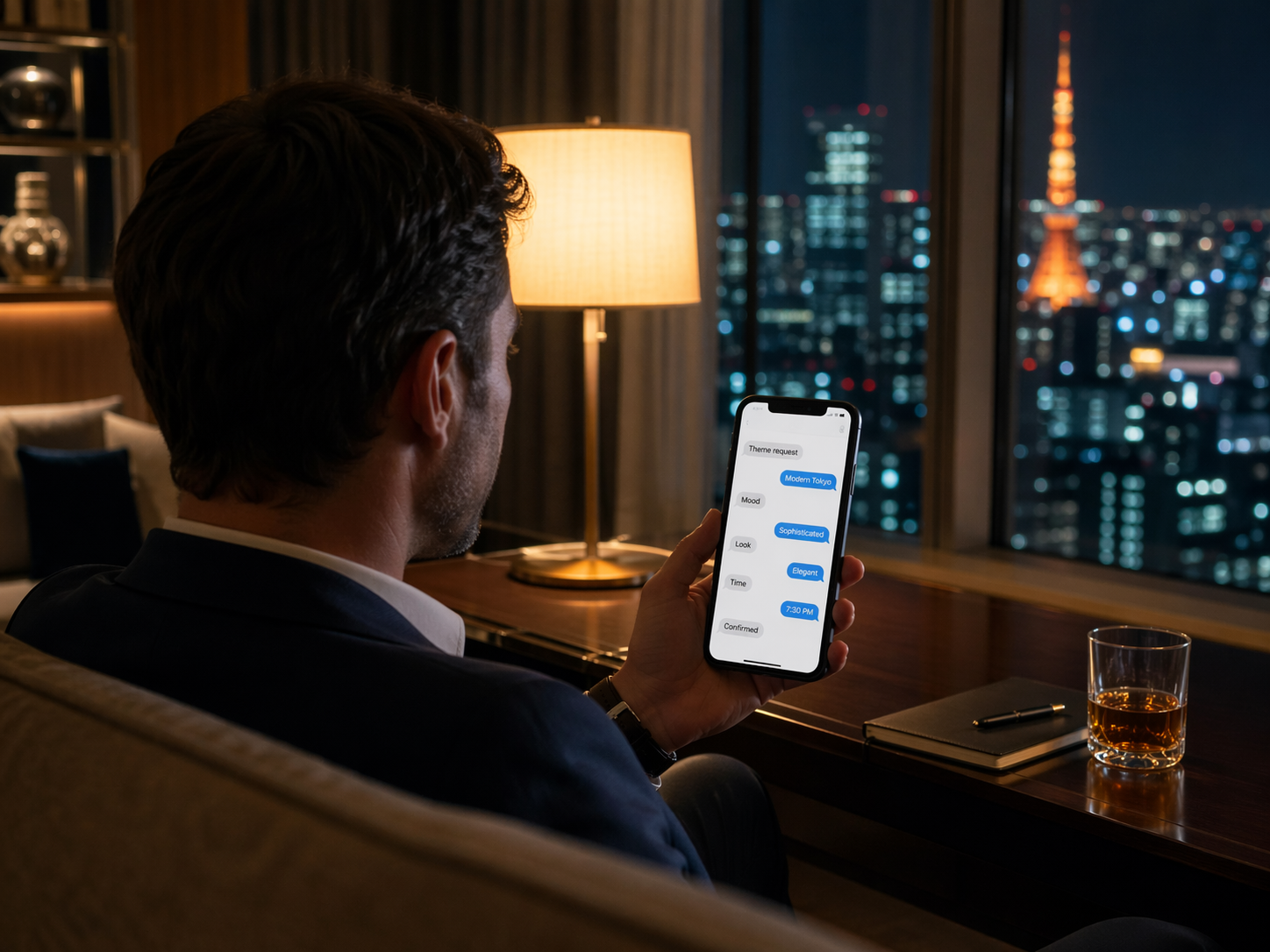
MIRAI TOKYO runs theme requests as a concierge conversation, not a self-service form. For a request that originates in eroge or ero-anime vocabulary, the practical flow looks like this:
- Browse profiles first: Every MIRAI TOKYO companion profile is photographed by the team—no panel-editing (パネマジ) mismatch. Looking at a few profiles before writing your message grounds your mood and look preferences in real options.
- Write the first message in mood → look → scenario → options order: Short and specific wins. The concierge reads it, proposes one or two profile matches, confirms costume availability if requested, and sends a total price in writing.
- Confirm total before booking: Rank-based course fees (Silver ¥37,000–¥85,000 through Diamond ¥70,000–¥170,000 for 60–180 minutes), Photo Selection ¥2,000, Repeat Request ¥5,000, extensions from ¥20,000 per 30 minutes. Transportation is free within Minato Ward.
- English across channels: LINE, WhatsApp, WeChat, Instagram, KakaoTalk, web form—all in English. The theme conversation can happen in whichever channel you already use.
- Published house rules: The public “How to Use” page lists what isn’t accepted: no minors, no full service, no photography, no drugs, no intoxication, no STIs, no violence, no multiple persons. Those are hard lines, not soft preferences.
For the theme-and-fantasy lens specifically, the parallel guide Hentai-Inspired Fantasy Nights in Tokyo focuses on the theme/costume/mood layering. This guide is the expectations-and-boundaries companion to that one—read both together if you want the full translation map. For pricing detail see Pricing; for the booking flow see How to Use.

FAQ
Summary
Hentai games and ero-anime built a specific fantasy architecture: routes, true endings, harems, stat-gated scenes, character-scripted interactions. That architecture does not survive transit to a real Tokyo hotel room, and the failure modes are consistent—character reproduction, genre-tag requests, pre-written scripts, age ambiguity. What does survive is the theme, costume, and mood layering. Imekura’s scenario catalog (classroom, office, train, nurse, maid, bunny, night visit) is the native Japanese format for that kind of play; hotel-based premium outcall carries the mood layer cleanly, with cosplay outcall covering the costume-first variant. The translation rule is decomposition: break the fantasy into mood, look, scenario, and options, send those to a concierge in that order, and a realistic match follows. MIRAI TOKYO handles this as a concierge conversation with English support, published pricing, and explicit house rules—which is, in the end, what a good translation of an eroge fantasy into an actual night looks like.
Translate Your Eroge-Influenced Fantasy into a Real Booking
MIRAI TOKYO’s Roppongi concierge handles theme requests as a conversation, not a form. Mood, look, scenario, options—decomposed, matched to real profiles, priced in writing before you commit. English support across every channel.
 How to Book
About This Guide
This guide was prepared and reviewed by the MIRAI TOKYO concierge team. References to the visual-novel and eroge lineage, route structures, and character-creator games reflect broadly documented genre conventions rather than a specific publication. Imekura scenario details reflect conventions documented in Japanese-language industry sources. Japanese legal references cite the Act on Punishment of Activities Relating to Child Prostitution and Child Pornography and the Amusement Business Act (風営法). MIRAI TOKYO operating details follow the published pricing and how-to-use pages.
This content is for informational purposes only and describes cultural and commercial context around adult-industry terminology and fan vocabulary. It does not depict or endorse any illegal activity. Readers should verify current regulations and individual operator policies before engaging any service.