











 MIRAI TOKYO concierge team

If you searched for “threesome outcall Tokyo,” you need four pieces of information before anything else. One: two-companion outcall in Tokyo is available as FFM only—one male guest with two female companions. Two: the price is two companions’ fees, not one. Three: two male guests with one female companion (MMF) is not accepted, and this reflects standard industry convention in Japan, not a quirk of one operator. Four: same-night requests rarely succeed; this kind of booking needs at least 24 to 48 hours of lead time. The rest of this guide explains why those rules exist, how the pricing actually works, what the Japanese industry terms (二輪車 / 逆二輪車 / ダブル) mean, and how MIRAI TOKYO handles the booking end-to-end.
Table of Contents
Can You Book Two Companions for One Guest in Tokyo?
Yes—as FFM, and with four conditions. To keep the conditions in one place so you don’t lose them scrolling:
- Configuration: One male guest, two female companions. This is the only configuration accepted.
- Pricing: Per-companion fees apply, and the exact total depends on the specific configuration. Because two-companion pricing varies by booking, please contact the concierge for a written total before committing.
- Not accepted: Two male guests with one female companion (MMF / 逆二輪車), or any configuration with more than one male guest. This is MIRAI TOKYO’s policy and matches the standard position of the Japanese premium outcall industry.
- Lead time: Recommended 24 to 48 hours minimum. Same-night two-companion requests rarely close because two separate companion schedules need to align.
The rest of this article explains each of these conditions in detail. If you need the policy only, the section above is sufficient. For pricing and logistics, read on.
FFM Only: The Japanese Industry Convention
The FFM-only rule is not a preference dressed up as a policy. Across the Japanese premium outcall market, FFM is the default two-companion configuration, and MMF is a clearly separate category that most reputable operators do not serve. Three structural reasons sit behind this.
Companion safety and consent
An outcall session is a one-on-one arrangement inside a hotel room. A two-companion-one-guest booking preserves the dynamic where companions are at parity; a two-guest-one-companion booking does not. The risk profile for the companion shifts materially, and most reputable operators do not accept bookings their companions cannot consent to on the same terms as a standard session.
Operational coordination
FFM is coordinated between two companions who share a workplace, can align on the booking, and can read the room together. MMF assumes coordination between two guests who are supposed to arrive together at a hotel—something the operator has no control over and no easy way to screen for. Japanese operators avoid that category of risk.
Cultural and commercial norms
Japan’s adult-entertainment conventions, including its widely circulated AV (adult video) content, treat FFM (often labeled “harem” in that context) as the dominant multi-partner configuration. MMF variants exist but are niche and are not a standard option in the premium outcall segment. This isn’t a legal rule; it’s a market norm, reinforced by how companions are recruited, trained, and paired.
Decoding the Terminology Gap
English “threesome” flattens several distinct ideas that Japanese industry vocabulary keeps separate. Once you know the four Japanese terms below, you can read any Tokyo rate card intelligently.
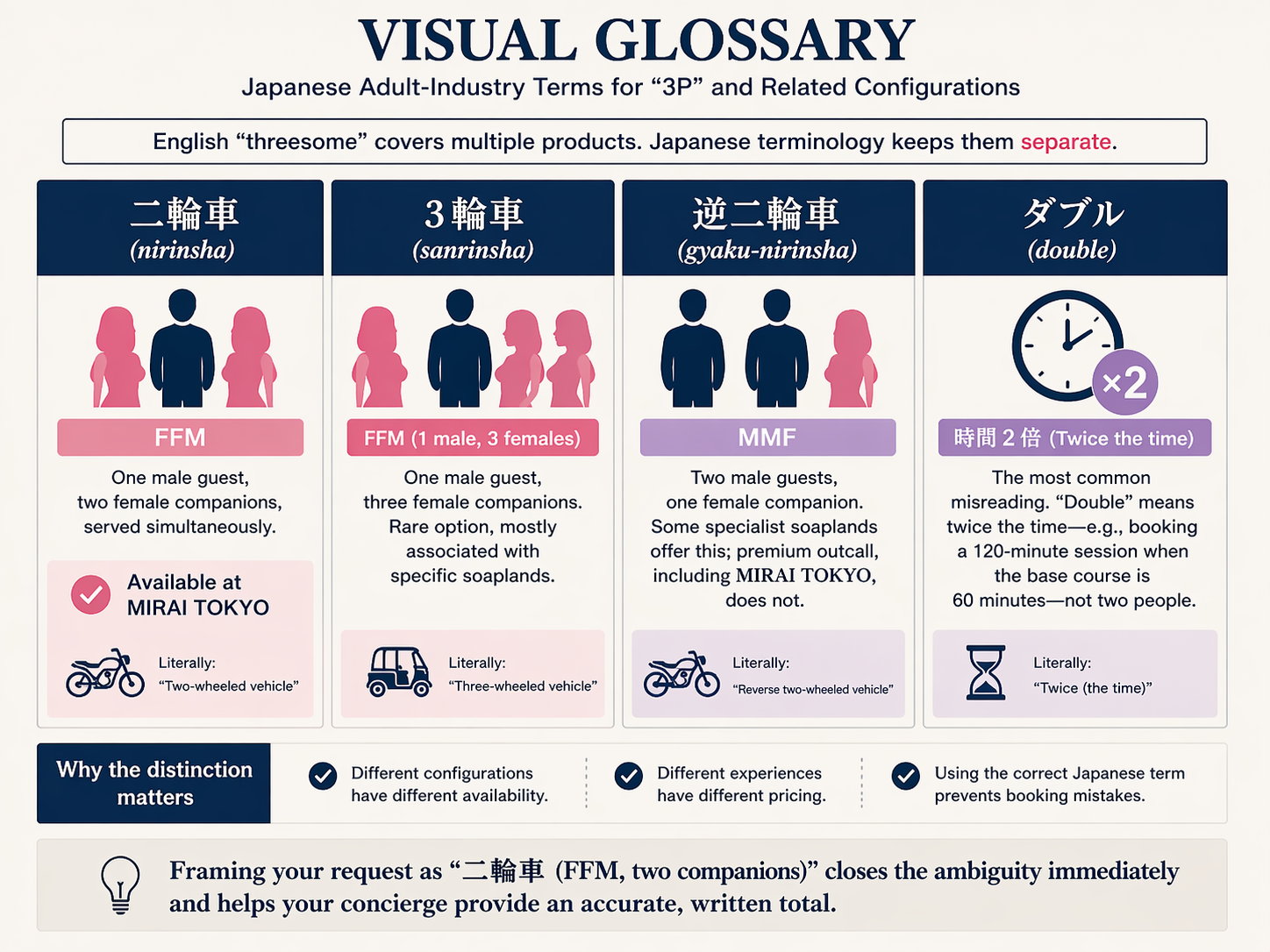
- 二輪車 (nirinsha): Literally “two-wheeled vehicle.” The standard term for FFM—one male guest, two female companions, served simultaneously. This is the configuration available at MIRAI TOKYO.
- 3輪車 (sanrinsha): “Three-wheeled.” One male guest, three female companions. A rare option, mostly associated with specific soaplands.
- 逆二輪車 (gyaku-nirinsha): “Reverse two-wheeled.” MMF—two male guests, one female companion. Some specialist soaplands offer this; premium outcall, including MIRAI TOKYO, does not.
- ダブル (double): This is the most common misreading. “Double” in Japanese adult-industry vocabulary means twice the time—booking a 120-minute session when the base course is 60 minutes—not two people. Rate cards that advertise “ダブル” are usually describing duration, not headcount.
The English word “threesome” covers FFM, MMF, and sometimes more. In Japanese industry terms, these are different products with different availability and different pricing. Framing a request as “I’d like to book a 二輪車 (FFM, two companions)” closes the ambiguity immediately.
How Pricing Works for Two Companions
A two-companion booking involves per-companion fees, with the exact total depending on several variables that are confirmed at inquiry rather than pre-calculated.
The total is shaped by the specific configuration you request: the ranks chosen, session duration, which nomination type applies to each companion, the hotel’s location for transportation, and whether you plan to extend. Because these variables combine differently for each booking, two-companion totals are not quoted as a fixed formula.
Please contact the concierge for a written total breakdown specific to your requested configuration before committing. For reference, published single-booking rates—rank-based course fees (Silver through Diamond), Photo Selection, Repeat Request, extension rates, and transportation tiers—are available on the Pricing page, and the concierge applies these to your specific two-companion request.
Same-day cancellation follows the standard industry rate (100% of the booked total). If you may extend, flagging that in your first message helps the concierge account for it in the written total.

Transparent Pricing & Rates - 3 Tiers | MIRAI TOKYO
Transparent pricing for Tokyo luxury escort service: Silver (¥37,000-¥85,000), Gold (¥45,000-¥105,000), Diamond (¥70,000-¥170,000). Time-based sessions from 60-180 minutes. No hidden fees. Free transportation within Roppongi area. English payment assistance available.
Hotel Room Occupancy and Advance Timing
Two-companion bookings have two logistical realities most first-time guests don’t anticipate.
Hotel room occupancy
Many luxury Tokyo hotels cap room occupancy at two to three people, and the truly three-person-capable rooms are a specific subset of the property’s inventory. If the room you booked is a standard double, the hotel may object to three-person entry—enforcement varies by property, but the risk is yours to manage. Either request a room that can accommodate three at check-in, or plan arrival patterns around the room’s declared capacity.
Advance timing
A two-companion booking requires aligning two separate companion schedules, confirming joint consent, and handling the logistics of a joint arrival. That is three conversations on the operator’s side, not one. On a quiet weeknight, 24 hours of lead time is usually enough; on a peak weekend, 48 to 72 hours is more realistic. Same-night FFM requests occasionally succeed, but the odds drop sharply compared to a single-companion booking.
The Booking Flow Step by Step
-
Step 1: Send your request with the full context
Date, time window, hotel name and room number (or room type if not yet assigned), preferred course duration, two preferred companions (or “similar profiles” as fallback), and your budget range. A complete first message saves hours.
-
Step 2: Joint availability and consent confirmation
The operator confirms that both companions are available for the same window and that they consent to the joint booking. This step is not instant; expect a window of one to a few hours, longer on peak nights.
-
Step 3: Written total
You receive the concierge’s written breakdown for your specific booking—course fees, any applicable nomination fees, transportation, extension policy, and cancellation policy. Confirm the total before the operator holds the pairing.
-
Step 4: Hotel and arrival pattern
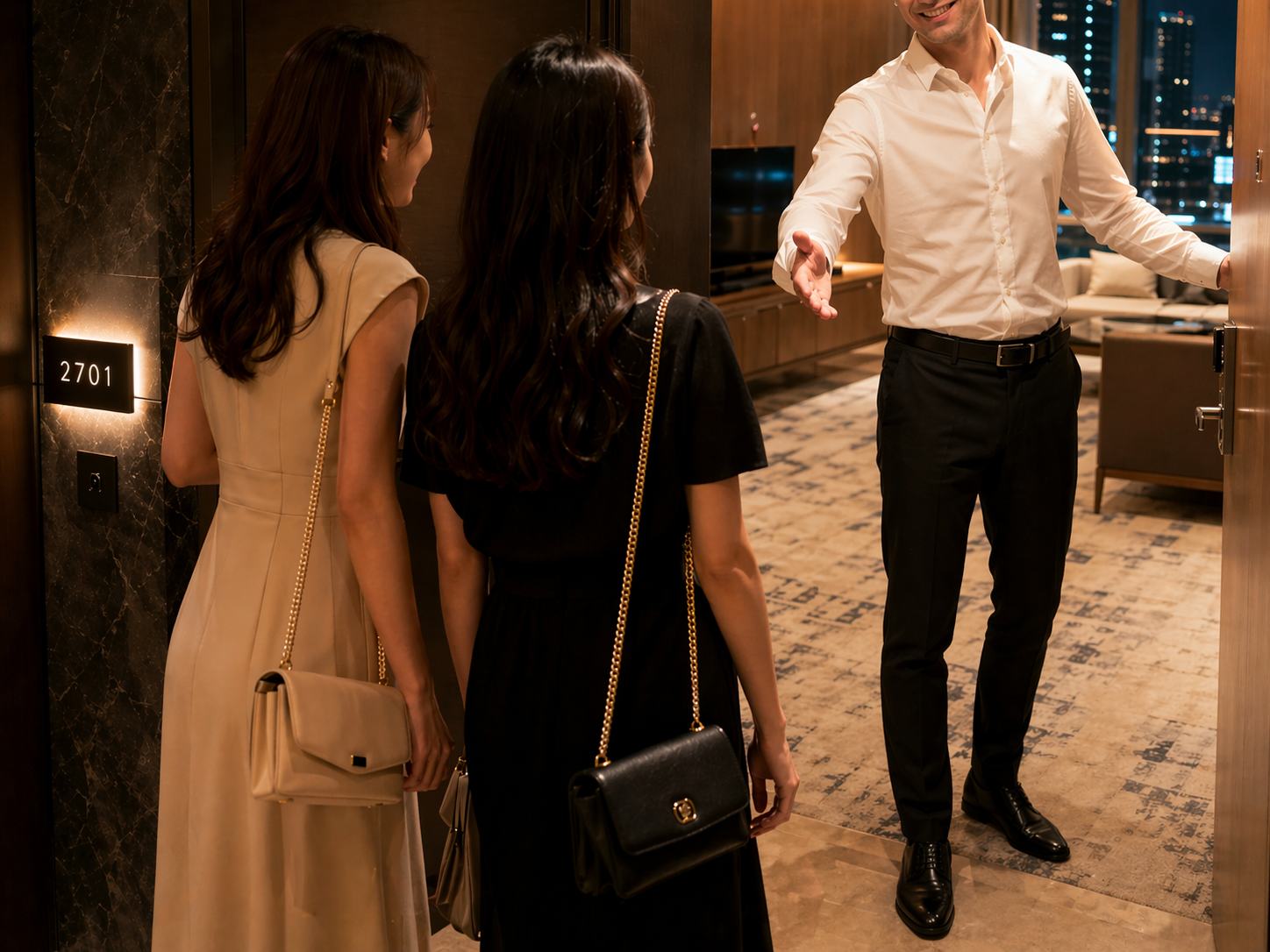
Confirm the hotel name, room number, and how the companions will arrive—together, or with a short stagger to keep lobby presence low-key. At a luxury property, the stagger is usually preferred.
-
Step 5: Arrival and session
Both companions arrive per the agreed pattern. The session follows the confirmed terms. Extension, if chosen, must be agreed within the session window and applies to both companions simultaneously.
Booking Guide - 4 Easy Steps | MIRAI TOKYO
Complete guide to booking luxury escort service in Tokyo: 4-step process from inquiry to arrival. Available via phone, LINE, WeChat, WhatsApp. English support, discreet service, legal compliance explained. Learn about Japan's outcall escort culture and regulations.
How MIRAI TOKYO Handles Two-Companion Bookings
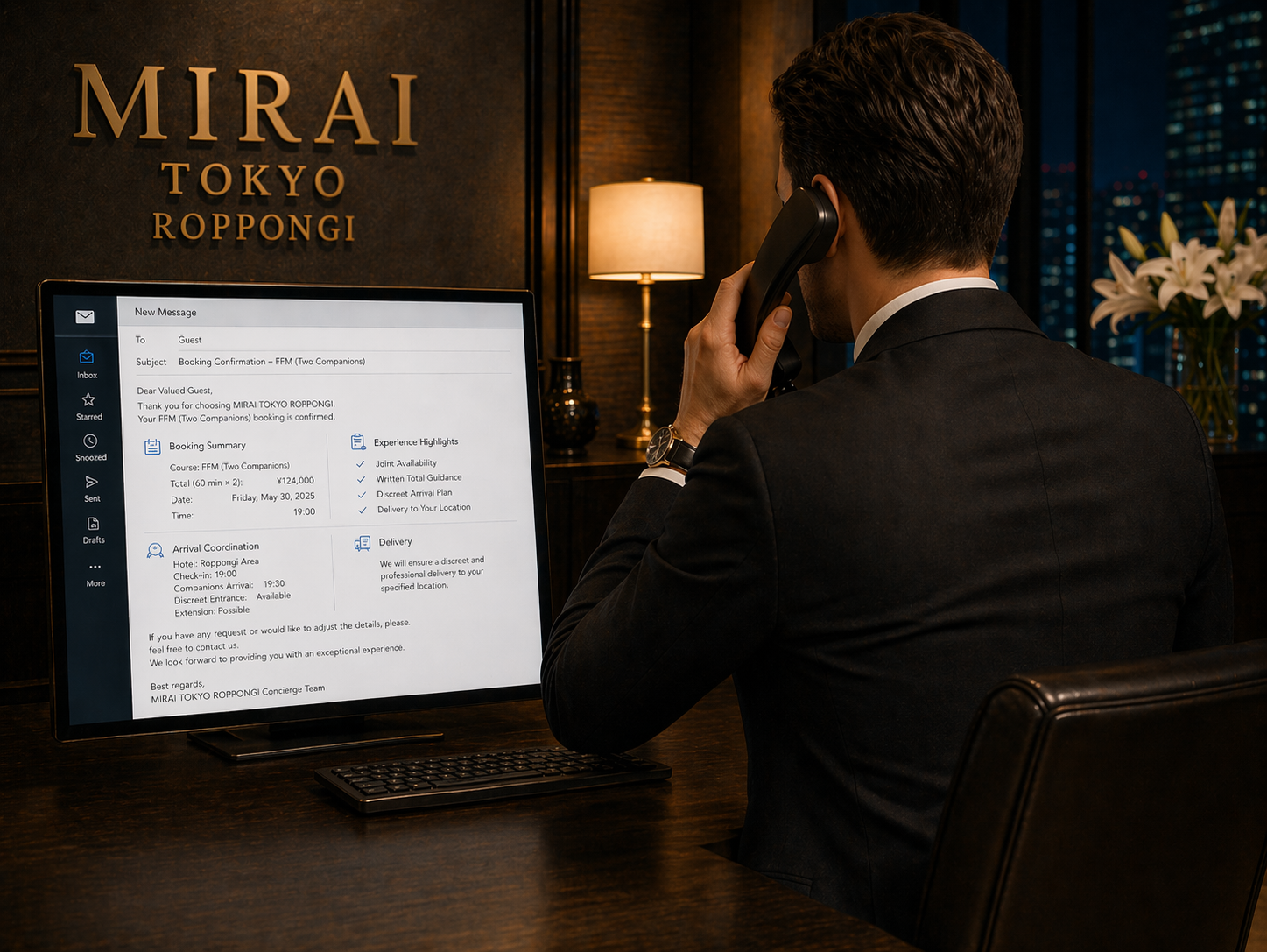
MIRAI TOKYO is based in Roppongi and serves luxury hotels across central Tokyo. Two-companion bookings are handled as a concierge coordination rather than a self-service flow, which is the appropriate shape for this category of booking.
- Configuration: FFM only, one male guest. MMF and multi-male configurations are not accepted. This is consistent across MIRAI TOKYO’s service, aligned with broader Japanese industry convention.
- Pairing: The concierge identifies two companions with aligned availability and mutual consent for a joint booking. Mixed-rank pairs are routine (e.g., Silver + Gold, Platinum × 2).
- Pricing transparency: Two-companion totals are sent in writing before holding the pairing. All component fees are published on the public pricing page.
- English across all channels: LINE, WhatsApp, WeChat, Instagram, KakaoTalk, web form. No Japanese language barrier at any point.
- Hotel arrival pattern: The team plans arrival to match the hotel’s profile—staggered entry at luxury properties, simultaneous entry where preferred and appropriate.
- Published rules apply fully: No minors, no full service, no photography, no drugs, no intoxication, no STIs, no violence, no multiple persons (MMF). These are not negotiable.
For the practical checklist of everything to confirm before committing—fee items, pair selection strategy, hotel etiquette, English message templates—see the companion article Booking Two Companions in Tokyo. For rate details see Pricing; for contact steps see How to Use.
FAQ
Summary
Two-companion outcall in Tokyo works—on the FFM configuration, with per-companion pricing confirmed by the concierge on inquiry, with 24 to 48 hours of advance time, and within the hotel-occupancy reality of a three-person stay. MMF and multi-male configurations are not offered, in line with broader Japanese industry convention. The Japanese vocabulary (二輪車 for FFM, 逆二輪車 for MMF, ダブル for double-time) clarifies what the English word “threesome” leaves ambiguous. The booking is a concierge coordination, not a self-service click—and that is the right shape for this category of request.
Plan an FFM Two-Companion Booking in Central Tokyo
MIRAI TOKYO’s Roppongi concierge handles two-companion (FFM, one male guest) bookings end-to-end in English—joint availability, written pricing, hotel arrival planning. 24–48 hours advance booking recommended.
 How to Book
About This Guide
This guide was prepared and reviewed by the MIRAI TOKYO concierge team. Japanese industry terminology (二輪車 / 3輪車 / 逆二輪車 / ダブル) follows conventions documented in Japanese-language references including Wikipedia entries on ソープランド. Pricing reflects MIRAI TOKYO’s published rates on the official site; total-price structure for two-companion bookings is in line with general Japanese outcall industry practice. The FFM-only policy matches industry standards and is listed in MIRAI TOKYO’s public house rules.
This content is for informational purposes only and does not constitute legal advice. It describes adult-companion booking conventions and policies. Individual operator policies and pricing may change; always confirm current terms directly with the operator before booking.