











 MIRAI TOKYO concierge team

Deriheru. Fashion health. Hotel health. Read them in English, and the three terms feel interchangeable—something to do with delivery, something to do with fashion, something to do with hotels. Read them in Japan’s adult industry context, and they are three distinct business formats with different legal classifications, different venues, different pricing structures, and different levels of accessibility for foreign visitors. The history matters too: one of them emerged in the late 1980s, one of them effectively replaced the other starting in 1999, and the third sits in a blurred category that drifts between both. This guide unpacks all three, explains what each format is actually doing, and shows which one makes sense for a foreign guest staying at a Tokyo luxury hotel.
Table of Contents
A Brief History of How Three Formats Emerged
The three formats covered here did not appear in a vacuum. They are each responses to Japan’s Anti-Prostitution Act of 1956, whose narrow definition left legal room for non-coital adult-service categories to develop under the separate Amusement Business Act (風営法). Over the following decades, storefront formats (soapland, fashion health) emerged first, and a later revision of the Amusement Business Act created a formal non-storefront category—giving delivery health (deriheru) a defined legal home. From that point on, deriheru gradually displaced storefront fashion health as the dominant non-bath adult-service shape, while hotel health developed as a hybrid operating between them. More recent revisions of the Amusement Business Act have continued to strengthen enforcement against unnotified operations.
The short version: storefront fashion health is the older model; deriheru is the model that took over most of the market from the 1990s onward; hotel health occupies the structural space between them. Every difference below traces back to that trajectory.
What Each Term Actually Means
Deriheru (デリヘル / delivery health)
Non-storefront category under the Amusement Business Act. Operators run a dispatch office—not a venue customers visit. Bookings are placed by phone, website, or messaging app, and the companion is sent to the customer’s hotel room or residence. The office is not for walk-in. Services vary by shop, but the category as a whole is the dominant shape of Japan’s adult-outcall market today. “Deriheru” is both the legal category name and the most common industry shorthand.
Fashion health (ファッションヘルス)
Storefront category. The shop has a physical location with private rooms, and customers visit the shop for the service. The name is Japanese industry vocabulary, not an English loanword—”fashion” here is closer to “stylish / trendy” framing than to clothing; “health” is a legacy euphemism carried over from earlier adult-industry vocabulary. Fashion health was the dominant non-bath storefront model through the 1990s and has declined steadily since 1999 as deriheru expanded. Yokohama Akebonocho remains one of the largest concentrated fashion-health districts in Japan.
Hotel health (ホテヘル)
A hybrid, and the one that most confuses foreign readers. Most hotel-health operations in Tokyo function as deriheru variants—a small reception office (often a multi-tenant building near a love-hotel district), where the customer pays and confirms details, then the meet-up happens at a nearby love hotel. Some operators run as formal storefront businesses with designated love-hotel partnerships; these are a minority. The key practical point: “hotel” in “hotel health” refers to a love hotel, not a luxury city hotel. Hotel-health operations are not built to deliver companions to your Park Hyatt room.
Why Foreign Visitors Confuse These Three
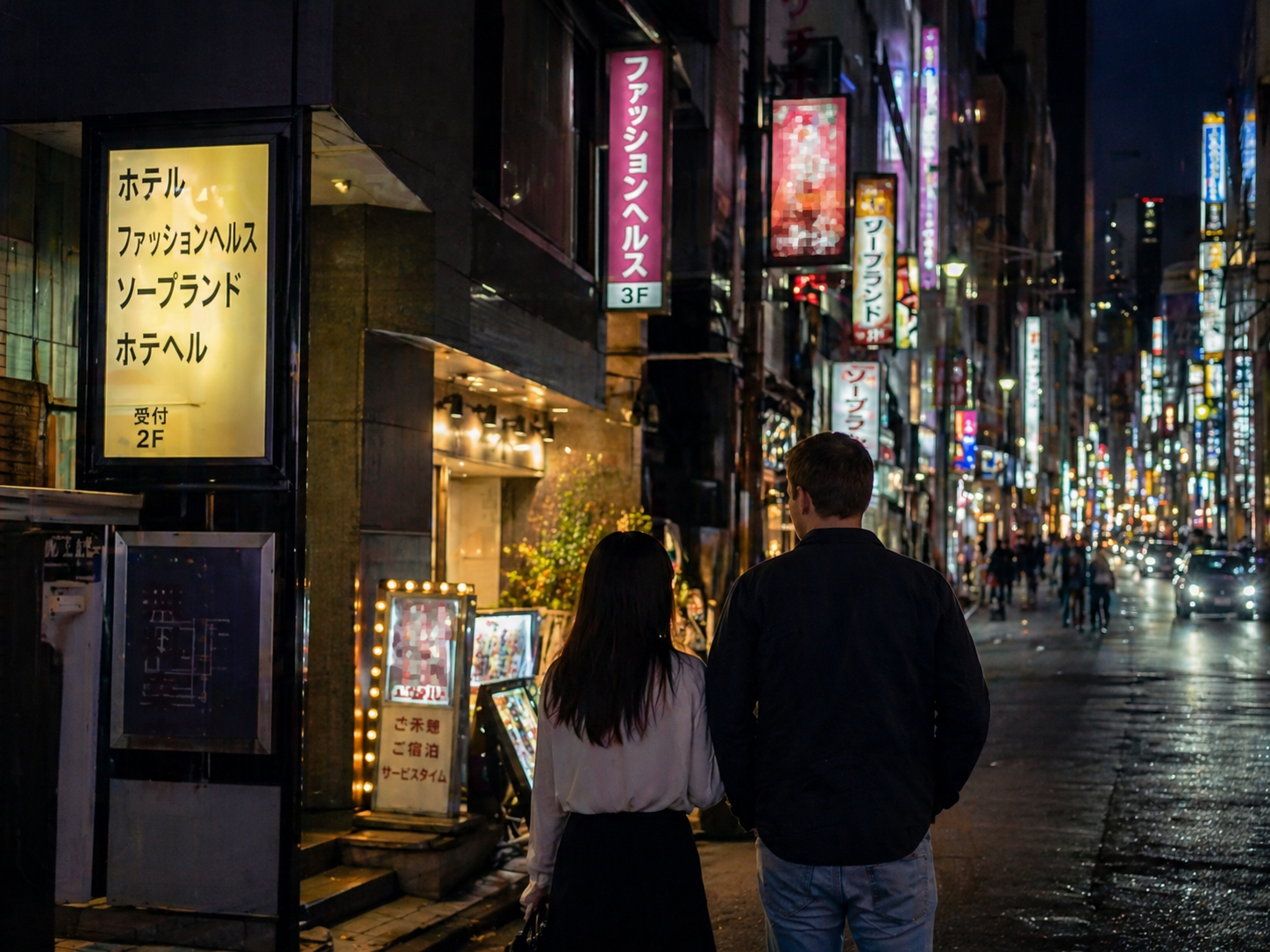
All three names are Japanese-language coinages using English-derived components. None of them map to what those English words mean in their original language:
- “Health” in this context does not mean wellness or medical. It is an industry euphemism that has been stable in Japanese adult-service vocabulary since the 1980s. It signals a non-bath private-room service, nothing more.
- “Delivery” does not evoke food delivery or parcel delivery to Japanese ears in this context—it signals dispatch of a companion. Foreign readers often misread it as the service physically bringing something.
- “Hotel” does not mean a commercial hotel. In industry shorthand, it refers specifically to love hotels. A foreign guest searching “hotel health delivery to my hotel” is combining a term with itself without noticing.
- “Fashion” has no meaningful connection to clothing in this usage—it is a category marker, not a descriptor.
English-language guides and aggregator sites compound the confusion by flattening all three into “Japanese adult services” or “Tokyo adult entertainment.” That is accurate at one level of abstraction and useless at the level you need to actually book something.
Side-by-Side Comparison
The usable differences across the three formats:
- Legal category: Deriheru = non-storefront. Fashion health = storefront. Hotel health = mostly non-storefront in practice, occasionally storefront.
- Where the service happens: Deriheru = customer’s hotel room or residence. Fashion health = inside the shop. Hotel health = nearby love hotel.
- Walk-in possible? Deriheru = no (dispatch only). Fashion health = yes. Hotel health = partial (customer visits a reception office).
- Price structure: Fashion health and hotel health usually sit in the lower-to-mid market, while general deriheru varies widely by tier. Premium hotel-based outcall sits much higher because it is built around hotel delivery, language support, and transparency.
- Foreign-language support: Uneven across all three in the general market. Premium operators (including within the deriheru category) build English support as a deliberate feature.
- Luxury-hotel compatibility: Deriheru premium operators = yes. General deriheru = varies. Fashion health = no (storefront). Hotel health = no (love-hotel-bound).
- Discretion: Deriheru premium = built for it. Fashion health = public storefront entry. Hotel health = public love-hotel-district entry.
For a foreign guest at a central-Tokyo luxury hotel, the usable format is premium deriheru. The storefront formats exist for a different customer profile.

What is Delivery Health (Deriheru) in Tokyo? The Risks to Know, and the Safer, Professional Alternat
Learn what “Delivery Health (Deriheru)” in Tokyo really means, the hidden risks around quality, hygiene, privacy and pricing, and how to choose a safer, professional outcall alternative as an international traveler.
Nearby Formats You Might Also See
The three formats above are not the whole map. A foreign visitor researching Tokyo’s adult market will also encounter the following; it is useful to know what they are in order to not confuse them with the three above.
Soapland
Storefront category, framed as a bath business. The service centers on bathing and mat-based experiences. Concentrated in Yoshiwara (Taito Ward) and equivalent districts elsewhere. Pricing typically sits above mass-market deriheru and fashion health, and can rise sharply at premium Yoshiwara stores. Many soaplands do not accept non-Japanese-speaking customers; accessibility for foreign visitors without Japanese is very limited.
Imekura (image club / イメクラ)
Storefront category, specializing in cosplay-and-scenario-based play. Private rooms designed to match specific scenarios (classroom, nurse’s office, office scenes). Pricing roughly parallel to fashion health. Foreign-language support uncommon.
Pinsaro (pink salon / ピンサロ)
Storefront category, focused on oral services in an in-shop setting. Typically lower priced than fashion health or deriheru. Rarely relevant to a foreign hotel guest.
Men’s esthetic (メンズエステ)
Generally marketed as a non-sexual relaxation/esthetic category rather than an adult-business notification category. Industry norms often refer to the “three prohibitions” (no undressing, no oral, no touching of male genital area). Genuine sexual service without the required legal framework creates serious legal risk, and the June 2025 revision made that significantly more consequential. Pricing usually sits far below premium hotel-based outcall, which is one reason the categories attract very different customer expectations.
Premium outcall (hotel-based)
Legally a subset of deriheru (non-storefront). Practically a distinct product, built for foreign guests at central-Tokyo luxury hotels. MIRAI TOKYO fits in this segment. Rates ¥37,000–¥170,000 by rank and duration.
Where You Find Each in Tokyo (and Beyond)
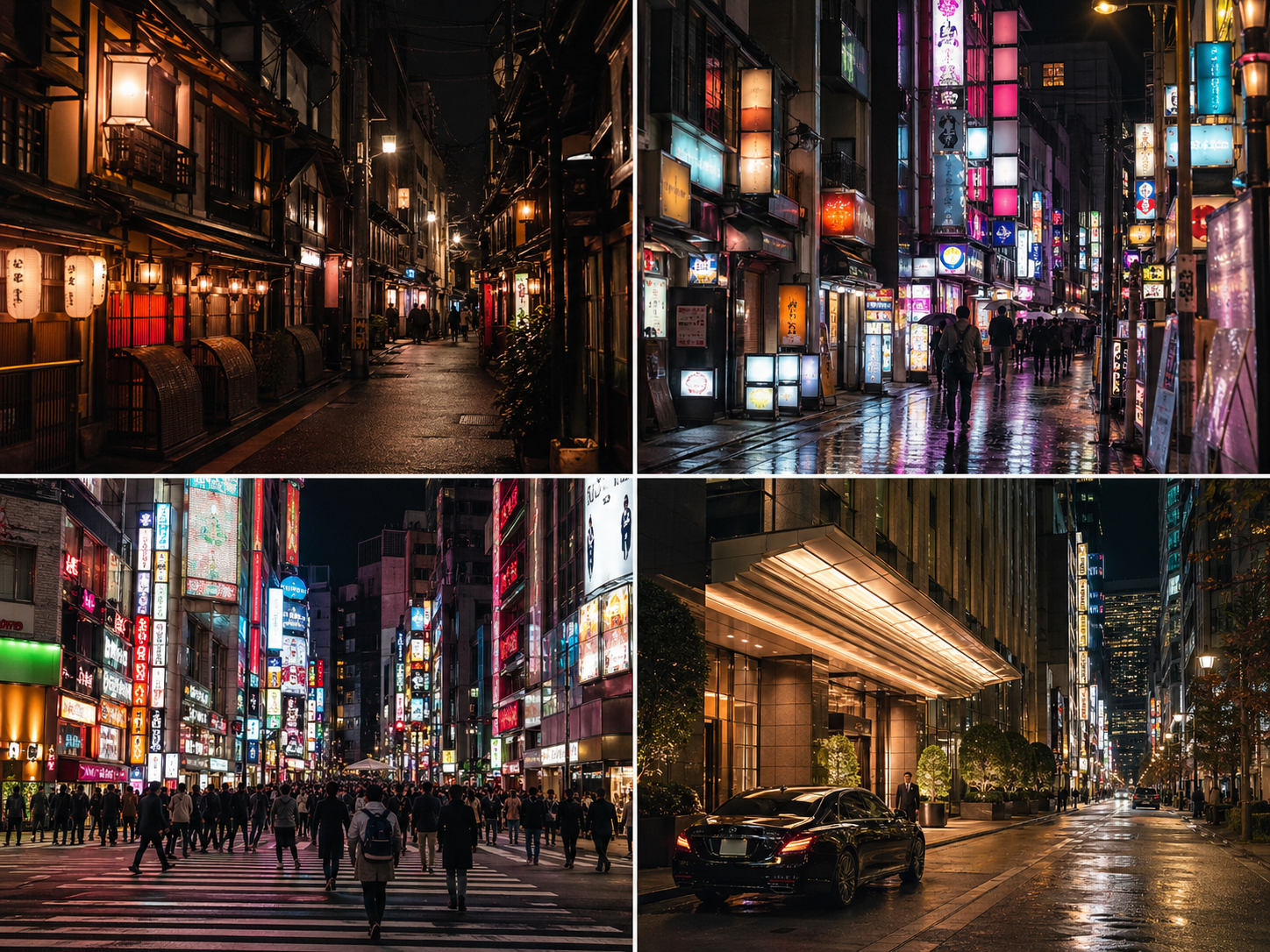
- Yoshiwara (Taito Ward, Senzoku 4-chome): The historic red-light district, now one of the world’s densest soapland concentrations. Not a deriheru or fashion-health district. Foreign-language accessibility is low.
- Yokohama Akebonocho: Japan’s largest remaining fashion health district. A storefront landscape, declining but still substantial.
- Kabukicho (Shinjuku): Mixed deriheru and hotel-health activity, plus the unlicensed-and-risky storefronts covered in the separate “red flags” guide. The most visible and the most foreign-tout-targeted district.
- Ikebukuro, Ueno, Uguisudani: High deriheru and hotel-health density, with significant love-hotel infrastructure.
- Roppongi, Akasaka, Ginza, Shinjuku-shopfront: The luxury-hotel corridor. Premium outcall operators concentrate here because their customers are here. MIRAI TOKYO is based in Roppongi for exactly this reason.
Which Format Fits a Foreign Hotel Guest?
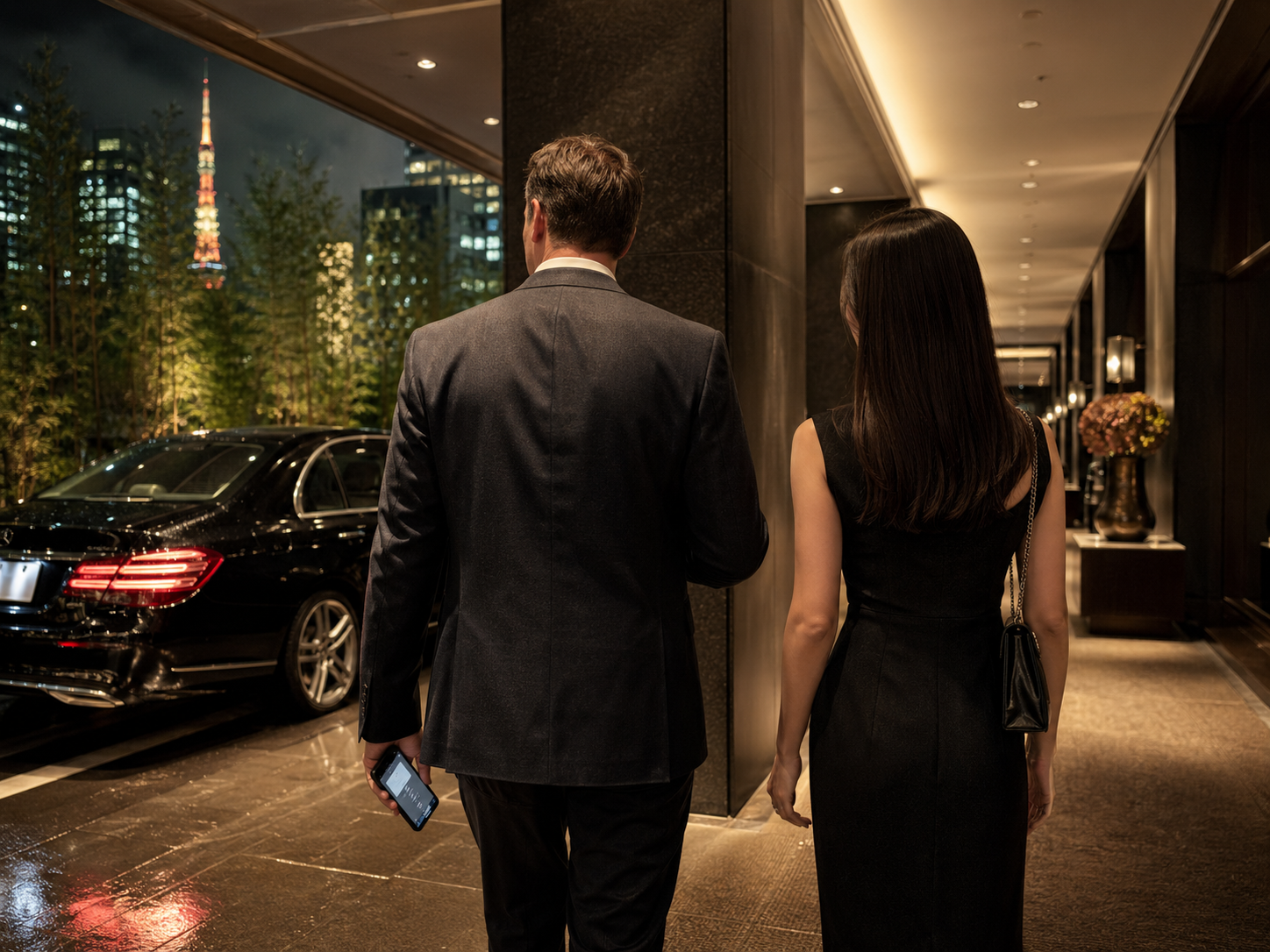
Put the three original formats against a single use case—”foreign guest staying at a luxury hotel in central Tokyo, English as primary language, wants privacy, transparent pricing, and direct hotel delivery”—and the answer is straightforward:
- Fashion health requires visiting a storefront in a specific district. Off the table.
- Hotel health routes you to a love hotel in a specific district. Off the table for the same reason.
- General deriheru is the right legal category but is optimized for the domestic Japanese market—limited English support, panel-based selection, variable transparency. Possible, but rough.
- Premium hotel-based outcall—the subset of deriheru built for this customer profile—fits the brief directly.
MIRAI TOKYO sits in this last category. Non-storefront notified operator, Roppongi base, luxury-hotel delivery, published pricing, English support across all channels, explicit house rules. For the format comparison in structural detail, see the companion guide Deriheru vs. Hotel Premium Outcall in Tokyo.
Booking Guide - 4 Easy Steps | MIRAI TOKYO
Complete guide to booking luxury escort service in Tokyo: 4-step process from inquiry to arrival. Available via phone, LINE, WeChat, WhatsApp. English support, discreet service, legal compliance explained. Learn about Japan's outcall escort culture and regulations.
FAQ
Premium Hotel-Based Outcall in Central Tokyo
MIRAI TOKYO operates in the premium subset of Japan’s non-storefront adult-service category. Roppongi-based, designed for foreign guests at central-Tokyo luxury hotels. English across every channel. Published pricing. No storefront, no love-hotel redirect.
 How to Book
Last Updated: 2026-04-25
This content is for informational purposes only and does not constitute legal advice. It describes Japanese adult-industry classifications and format distinctions for general reader comprehension. Individual operator policies, pricing, and availability may change; verify current conditions directly with any operator before engaging a service.