











 MIRAI TOKYO concierge team
Browse a Tokyo companion listing and you will notice two kinds of tags sitting side by side. Some describe how a companion looks—cute, beautiful, slender. Others describe how she works with you, and the clearest of these is the “Excellent Service” label. If you are trying to book an excellent service companion in Tokyo, the useful question is not “who is the prettiest?” but “who is tagged for the way she reads a room?” This guide explains what the service-focused type actually means, how it differs from a looks-first pick, what such a tag is meant to signal once she is in your hotel room, and how to combine the tag with rank, fees, and timing so the profile you choose matches the evening you want.
“Excellent Service” is not a price rank. It is a companion attribute that sits on the same filter row as looks-based tags, and it points at attentiveness, pacing, and hospitality rather than appearance. For a foreign guest with a language gap, that attribute often matters more than any photo.
Table of Contents
- What “Excellent Service” Means When You Browse Tokyo Companions
- Looks-First vs. Service-First: Two Ways to Read a Profile
- What a Service-Focused Tag Is Meant to Signal
- Why This Type Fits Foreign Hotel Guests Specifically
- How to Choose: Combining the Tag with Rank and Timing
- How MIRAI TOKYO Tags and Verifies Service-Focused Companions
- FAQ
- Summary
What “Excellent Service” Means When You Browse Tokyo Companions
On a Tokyo companion listing, “Excellent Service” is a selectable attribute—one of the filters a guest can use to narrow down profiles. At MIRAI TOKYO it appears alongside descriptive tags such as Cute, Beautiful, Slender, Large Bust, Cheerful, Amateur Style, Passive, and Recommendation. Most of those tags answer “what does she look like?” The service-focused tag answers a different question: “how does she treat the guest?”
That distinction matters because appearance is the easy thing to judge from a photo and the hospitality style is the hard thing. A picture tells you a companion’s look. It tells you almost nothing about whether she notices that your flight landed three hours ago, whether she adjusts her pace when you are tired, or whether she can carry a relaxed conversation across a language gap. The “Excellent Service” type is best read as the operator’s signal for companions associated with that second set of qualities.
It helps to be precise about what the label is not. It is not a price rank—those are separate (SILVER, GOLD, PLATINUM, DIAMOND, and a non-public ASK tier). It is not a promise of any specific physical act; legitimate operators publish clear limits on what is and is not accepted. It is a signal about temperament and attentiveness—the way a companion manages the hour rather than the way she photographs.
Looks-First vs. Service-First: Two Ways to Read a Profile
Every companion profile can be read along two axes at once. Understanding which axis a tag belongs to keeps you from mis-reading a listing.
What looks-based tags tell you—and what they don’t
Tags like Beautiful, Slender, or Large Bust are appearance filters. They are useful for narrowing a large roster to a visual preference quickly, and there is nothing wrong with starting there. But they are silent on the experience itself. Two companions with identical looks-based tags can run a completely different hour: one attentive and unhurried, the other going through motions. Looks tags cannot separate those two.
What service-oriented tags point toward
Attributes such as Excellent Service, Passive, Amateur Style, and Cheerful describe interaction style rather than appearance. “Passive” suggests a companion who follows the guest’s lead; “Cheerful” suggests an easy, bright mood; “Amateur Style” suggests a less polished, more natural manner. “Excellent Service” is the broadest of these—it flags companions consistently noted for attentiveness and hospitality across bookings. If you care more about how the time feels than about matching a specific look, the service-oriented row is the one to read first, then filter by appearance second.
What a Service-Focused Tag Is Meant to Signal
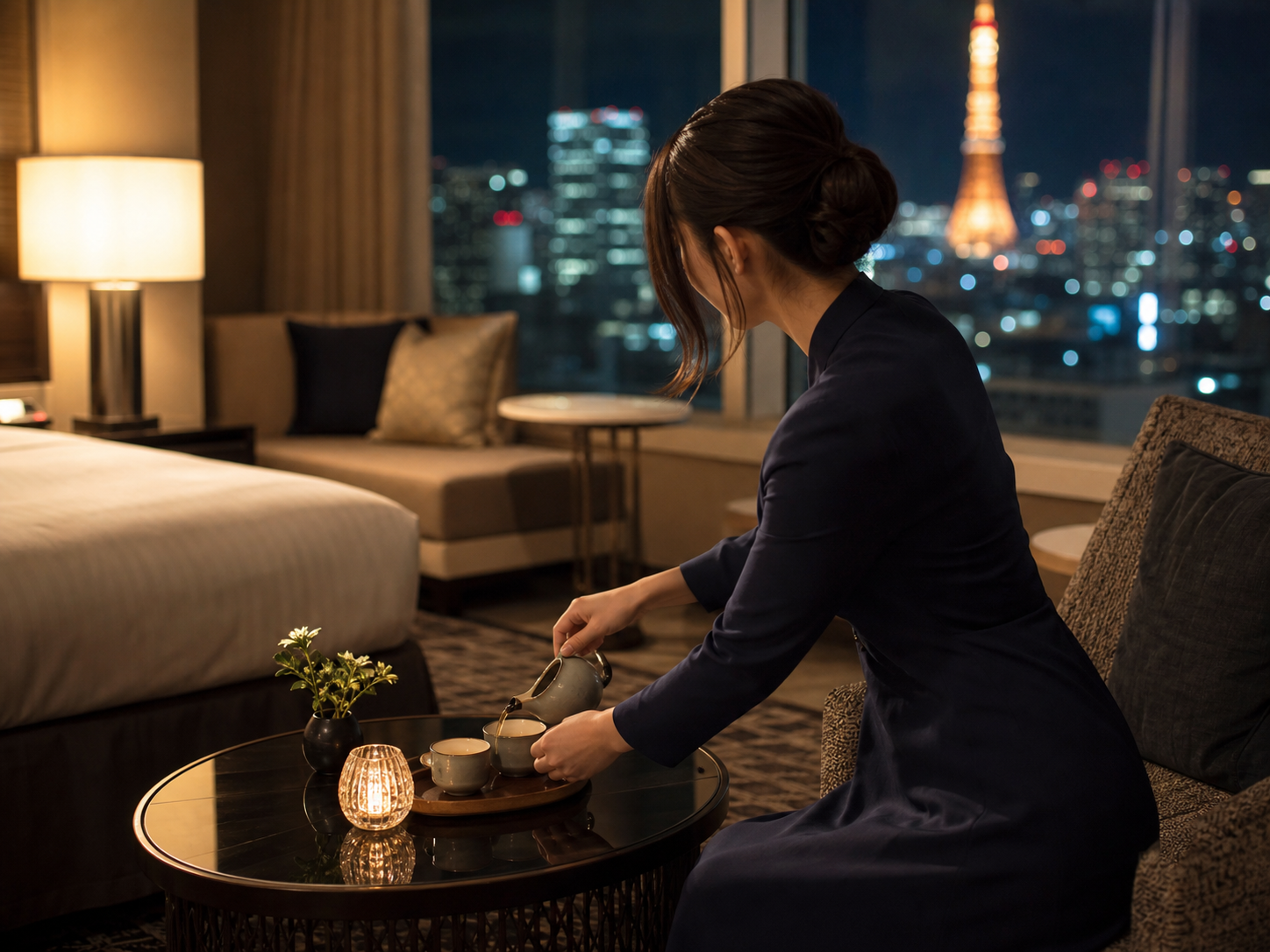
“Excellent service” sounds abstract until you translate it into the concrete things that happen during a booking. Stripped of marketing language, a service-focused companion tends to do a handful of specific things:
- Reads the opening minutes. A companion may notice whether you are wound up from a long day or relaxed and ready to talk, and sets the pace accordingly instead of rushing to a template.
- Calibrates conversation. She dials talk up or down to match your mood—light company when you want it, quiet when you don’t—rather than filling silence out of habit.
- Bridges the language gap. With a guest whose Japanese is limited, she keeps things simple, uses the messaging channel or a translation app without making it awkward, and confirms rather than assumes.
- Manages the time. She may pace the session so it does not feel front-loaded or rushed at the end, and handles the closing minutes with the same care as the arrival.
- Handles the hotel context. She is expected to understand discreet arrival at a luxury property and behaves in a way that does not draw attention in the corridor or lobby.
This is the everyday shape of omotenashi—the Japanese idea of anticipating a guest’s needs without making a show of the effort. What that hospitality standard looks like across a full high-class booking, and where its professional limits sit, is covered in the related guide below. The point for choosing a companion is simpler: the service-focused type is the one most likely to bring that anticipatory attention to your specific evening.
Japanese Hospitality: What to Expect from a High-Class Outcall Service (And What Not To)
What does true Japanese hospitality mean in a high-class outcall service? Learn what to expect, what not to expect, and how to enjoy a refined, professional in-room experience in Tokyo.
Why This Type Fits Foreign Hotel Guests Specifically
A service-focused companion is valuable for any guest, but the case is strongest for a foreign visitor staying at a hotel in central Tokyo. Three things line up.
First, the language gap. If you cannot easily explain what you want in the moment, you benefit most from a companion who reads cues and adjusts without needing a running commentary. That is precisely the skill the service tag flags. Second, first-visit nerves. Many foreign guests are booking this kind of service in Japan for the first time and are unsure of the etiquette; an attentive companion lowers the friction by leading gently rather than leaving you to figure it out. Third, the hotel setting itself. A luxury property in Roppongi, Akasaka, or Ginza rewards discretion, and a companion attuned to service is generally also attuned to arriving and behaving in a way that keeps the booking quiet.
Put differently: when you can articulate every preference fluently, looks-first selection costs you little. When there is a language barrier, the way a companion works carries more of the evening—so the service axis deserves more weight in your choice.
How to Choose: Combining the Tag with Rank and Timing
The service tag is one input, not the whole decision. Read it together with the parts of a profile that are concrete and published.
- Tag first, look second. If experience quality is your priority, start from the service-oriented filter, then narrow by appearance—rather than the reverse.
- Rank is price, not manner. Ranks (SILVER, GOLD, PLATINUM, DIAMOND, plus a non-public ASK) set the fee band and typically reflect popularity and profile, not politeness. A service-focused companion can appear at more than one rank, so pick the rank that fits your budget and read the tag separately.
- Nomination fees are small and worth it for repeats. Photo nomination—choosing a specific companion yourself—is listed publicly at ¥2,000. If you return and request the same person, repeat nomination is ¥5,000. There is no membership fee. For a guest who found a service-focused companion who worked well, the repeat fee is the cheapest way to protect a good match.
- Timing affects who is actually available. Booking is recommended two to three hours ahead, with same-night requests considered when schedules allow, and hours run 10:00 to 06:00. The most-requested service-focused companions book out first, so earlier contact widens your choice.
If your aim is less about picking a profile and more about how the whole evening is paced and kept discreet, the companion piece below covers that side. Here, the takeaway is a reading method: tag for manner, rank for budget, fee for repeats, timing for availability.

The Smart Gentleman’s Guide to Tokyo: An Evening with Japan's Top-Class Talent (Fully Discreet)
A smart gentleman’s guide to a discreet, world-class Tokyo evening. Learn how to enjoy top-class in-room experiences with privacy, quality, and professional English support.
How MIRAI TOKYO Tags and Verifies Service-Focused Companions

MIRAI TOKYO carries the “Excellent Service” attribute as a live filter on its companion listing, sitting next to appearance tags so a guest can choose along either axis. A few structural details make that tag more than a label:
- Photo-authentic, verified profiles. The roster is presented as verified and photographed in-house, so the person who arrives matches the profile you read. A service tag is only useful on a profile you can trust.
- Published, rank-based pricing. SILVER (¥37,000–¥85,000 for 60–180 minutes), GOLD (¥45,000–¥105,000), PLATINUM (¥57,000–¥138,000), DIAMOND (¥70,000–¥170,000), and a non-public ASK tier—so the manner tag and the money are read separately, in the open.
- Transparent fees. Photo nomination ¥2,000, repeat nomination ¥5,000, and no membership fee.
- English across every channel. LINE, WhatsApp, WeChat, Instagram, KakaoTalk, and a web form—so a service-focused companion’s attentiveness is not lost to a communication breakdown before the booking even starts.
- Published rules. The public “How to Use” page states what is not accepted (no minors, no full service, no photography, no drugs, no intoxicated clients, no STIs, no violence, no multiple persons)—the boundaries inside which “excellent service” is delivered.
Read together, these mean the service-focused type at MIRAI TOKYO is a verifiable attribute on a transparent profile, not a slogan. You can filter for it, cross-check it against a photo-authentic profile and a published price, and confirm availability through an English channel before you commit.
FAQ
Choosing by Manner, Not Just by Photo
If you take one thing into your next booking, make it this: read the companion listing along two axes, and give the service axis real weight. Filter for the “Excellent Service” type first if experience quality is your priority, then narrow by appearance, rank, and timing. Use photo nomination to lock in the specific companion you chose, book a few hours ahead through an English channel, and—if the match works—use repeat nomination to keep it. The photo tells you a look; the service tag tells you how the hour is likely to feel, and that is the part you cannot recover after the fact.
Browse Service-Focused Companions in Central Tokyo
MIRAI TOKYO is a non-storefront premium outcall service for luxury hotels across Roppongi, Akasaka, Ginza, Shinjuku, and central Tokyo. Filter verified, photo-authentic profiles by the “Excellent Service” attribute, read published pricing, and confirm in English before you book.

This content is for informational purposes only and does not constitute legal advice. It describes adult-companion selection conventions and operator policies. Individual operator policies, tags, and pricing may change; always confirm current terms directly with the operator before booking.