











 MIRAI TOKYO concierge team

Tokyo Bay’s waterfront is not one compact hotel district. Daiba is shaped by waterfront leisure and large hotels, Ariake by exhibitions and events, and Toyosu by a mix of homes, shopping, markets, and hotels. They may look close on a map, but their railway connections, street scale, and accommodation patterns create different kinds of stay. Each district also extends beyond a single station, so the practical base depends on where the property sits within the waterfront.
Start with the bay itself: decide whether waterfront leisure, event access, or mixed-use convenience matters most, then compare the nearest station and accommodation type. Visitor rules, building access, and transportation fees can be checked after you have narrowed the choice to a specific property.
Contents
- Three Tokyo Bay bases at a glance
- Daiba and Odaiba: waterfront full-service stays
- Ariake: events and business-oriented hotels
- Toyosu: a mixed-use waterfront base
- How accommodation type changes arrival planning
- Movement and arrival planning
- Transportation fees from MIRAI TOKYO
- From hotel decision to booking
- FAQ
Three Tokyo Bay bases at a glance
The most useful way to read the bay is as a choice among three types of base. Daiba and central Odaiba suit travelers who want a waterfront leisure setting and a larger full-service hotel. Ariake places exhibition venues, arenas, and business-oriented accommodation close to the center of the stay. Toyosu combines hotels with residential towers, shopping, the market district, and everyday city infrastructure.
None is automatically better for an outcall visit. The better choice is the one that fits the rest of your itinerary and offers an accommodation type whose access conditions you can verify. The comparison below turns each area into a decision rather than a list of attractions.
| Base | Best suited to | Accommodation tendency | Main trade-off | Station check |
|---|---|---|---|---|
| Daiba / Odaiba | A stay centered on waterfront leisure and the hotel itself | Large international or full-service properties | Large buildings and controlled guest circulation can add steps between entrance and room | Daiba, Odaiba-kaihinkoen, or Tokyo Teleport |
| Ariake | Exhibitions, conferences, arenas, and business schedules | Business, event, group, and large mixed-use hotels | A large venue zone can make the practical station and building entrance less obvious | Tokyo Big Sight, Ariake, or Kokusai-tenjijo |
| Toyosu / Shin-toyosu / Shijo-mae | Bay views with wider access to everyday Tokyo | Business and sightseeing hotels in several station zones | The Toyosu name covers distinct station areas rather than one compact hotel cluster | Toyosu, Shin-toyosu, or Shijo-mae |
Daiba and Odaiba: waterfront full-service stays
Daiba is the clearest choice when the hotel experience itself is part of the trip. The core waterfront has a small concentration of large full-service hotels, open views, promenades, and direct access to Odaiba’s leisure zone. Compared with the denser business-hotel pattern in central Tokyo, the setting feels more self-contained.
This can work well for a traveler who wants an international-style property with restaurants and other services in the building. It can also mean a larger lobby, more controlled guest circulation, and a longer route from the station platform to the room. The main trade-off is therefore operational: a polished full-service setting does not, by itself, tell you how a non-registered visitor is handled.
Transport depends on which side of Odaiba you use. Daiba and Odaiba-kaihinkoen are on the Yurikamome line. Tokyo Teleport is on the Rinkai Line, with services toward Oimachi, Osaki, Shibuya, and Shinjuku. A hotel that looks close on a district map may be oriented toward one station rather than the other, so the station name is more useful for arrival planning than the word “Odaiba” alone.

Ariake: events and business-oriented hotels
Ariake is shaped by Tokyo Big Sight, conference facilities, arenas, and event traffic. Its accommodation is correspondingly varied: business-oriented properties, larger international brands, and hotels integrated with commercial or entertainment complexes. This is often the logical base when an exhibition, convention, concert, or business schedule is the reason for being in the bay area.
The main advantage is proximity to the event district. The trade-off is that “near Ariake” can still describe hotels on different sides of a large venue zone. Check whether the practical station is Kokusai-tenjijo on the Rinkai Line or Ariake or Tokyo Big Sight on the Yurikamome. Aomi is farther west on the Yurikamome and is useful for access to venues and leisure facilities, but the official waterfront accommodation directory places the confirmed hotel cluster in Ariake rather than Aomi.
Event nights also change the rhythm of the neighborhood. Crowds may be heavy immediately after a show or exhibition, while the same routes can become quiet later. A property inside a large connected complex can have more than one public entrance, so the building side used after an event can matter to the final approach.

Toyosu: a mixed-use waterfront base
Toyosu has a different character. It is not primarily a resort cluster or an exhibition district. Residential towers, offices, shopping, recreation, and the market area share the waterfront, so the neighborhood continues to function as part of everyday Tokyo. That makes it a practical base for travelers who want bay views without spending the entire stay inside a visitor precinct.
Hotel location matters within Toyosu. The Toyosu Station side connects to both the Tokyo Metro Yurakucho Line and the Yurikamome and sits near a broad commercial and residential zone. Shin-toyosu and Shijo-mae are farther along the Yurikamome, closer to newer waterfront development and the market district. A property described as a “Toyosu hotel” may therefore serve a different itinerary depending on its nearest stop.
This spread is useful when choosing accommodation: Toyosu Station can suit broader city movement, while Shin-toyosu or Shijo-mae may suit plans centered on the immediate waterfront. The decision is less about which zone is more prestigious and more about whether the nearest line and the final walk match the rest of the stay.

How accommodation type changes arrival planning
An area guide should not imply that only luxury hotels are relevant. A city hotel or business hotel may suit the trip, while a serviced apartment, residence-style stay, or another appropriate private room can also be considered. These formats do not share one access model. At a full-service hotel, ask about the lobby and front-desk route. At a compact business hotel, check the non-registered visitor rule and room-key controls. At a serviced apartment or residence, ask how the auto-lock, intercom, building management, and building or unit name affect entry.
Those are planning categories, not guarantees. The confirmed example in Toyosu is a hotel rule that asks guests not to invite visitors to their rooms. Other properties can set different conditions. Do not infer permission from the room rate, brand, or the fact that a residence has a private entrance. Ask the property, in neutral terms, whether a non-registered adult visitor may enter the room, whether a meeting must remain in a public area, and what access procedure applies. If the answer is unclear, the condition remains unresolved.
A useful accommodation shortlist records four things:
-
Property identity
Save the official English and Japanese property names, full street address, tower or building name, and main contact number.
-
Nearest practical station
Note the line, station, exit, and whether the property is inside or connected to a larger complex.
-
Visitor permission
Confirm whether a non-registered adult visitor may enter the room and whether the property requires a front-desk, manager, or public-area procedure.
-
Building access
Check lift or key controls, auto-lock or intercom access, the late-night entrance, and the exact building or tower name.
Movement and arrival planning across the bay
The Yurikamome is the continuous waterfront spine. Its stations run from Shimbashi through Daiba, Aomi, Tokyo Big Sight, Ariake, Shijo-mae, and Shin-toyosu to Toyosu. The Rinkai Line provides a different east–west axis through Tokyo Teleport and Kokusai-tenjijo, connecting toward Oimachi, Osaki, and through services to western Tokyo. Toyosu Station adds the Yurakucho Line for movement toward central and northwestern Tokyo.
These lines explain how the districts relate to the rest of Tokyo, but they do not provide a fixed outcall arrival time. The companion’s location, booking time, road conditions, and the final approach to the property can affect the confirmed arrangement. Use the railway map to choose a convenient base for your own itinerary; confirm the actual appointment time with the MIRAI TOKYO concierge for the specific request.
Transportation fees from MIRAI TOKYO
After the accommodation and area questions are settled, the address determines the transportation-fee category. On the current MIRAI TOKYO pricing page, transportation within Minato Ward is free, while Koto Ward carries a separate fee of ¥3,000.
This distinction matters around Tokyo Bay because familiar area names cross administrative boundaries. Daiba addresses used by the main waterfront hotels are in Minato Ward, while Ariake, Aomi, Toyosu, Shin-toyosu, and Shijo-mae locations are generally in Koto Ward. The point is not to turn hotel selection into an address lesson. It is to avoid treating every place marketed as “Odaiba” or “Tokyo Bay” as one flat-fee zone.
Fees can change, and an unusual location or request may need individual confirmation. Before finalizing, send the MIRAI TOKYO concierge the property name and complete street address. Ask for the transportation fee together with the course and other booking terms, so the total is clear before the appointment is confirmed.
From hotel decision to booking
MIRAI TOKYO’s booking guide sets out the process: make an inquiry, choose a companion, confirm the date, time, location, payment, and terms, then meet at the agreed place. For a bay-area request, add the property name, full address, accommodation type, and the access condition you confirmed. Availability and arrival arrangements are then settled for the actual request.
FAQ
Choose the stay first, then confirm the booking details
Choose the character of the stay first: Daiba for a concentrated waterfront full-service setting, Ariake for exhibitions and events, or Toyosu for a mixed residential, commercial, and market-side base. Then choose the accommodation format and verify its access conditions. Use the full address last to confirm the transportation fee and appointment details.
If none of the bay-area accommodation formats meets your visitor and access requirements, a different Tokyo hotel district may be a better choice than trying to work around a property rule. The separate guide below explains Tokyo’s love hotel districts and their different accommodation format.
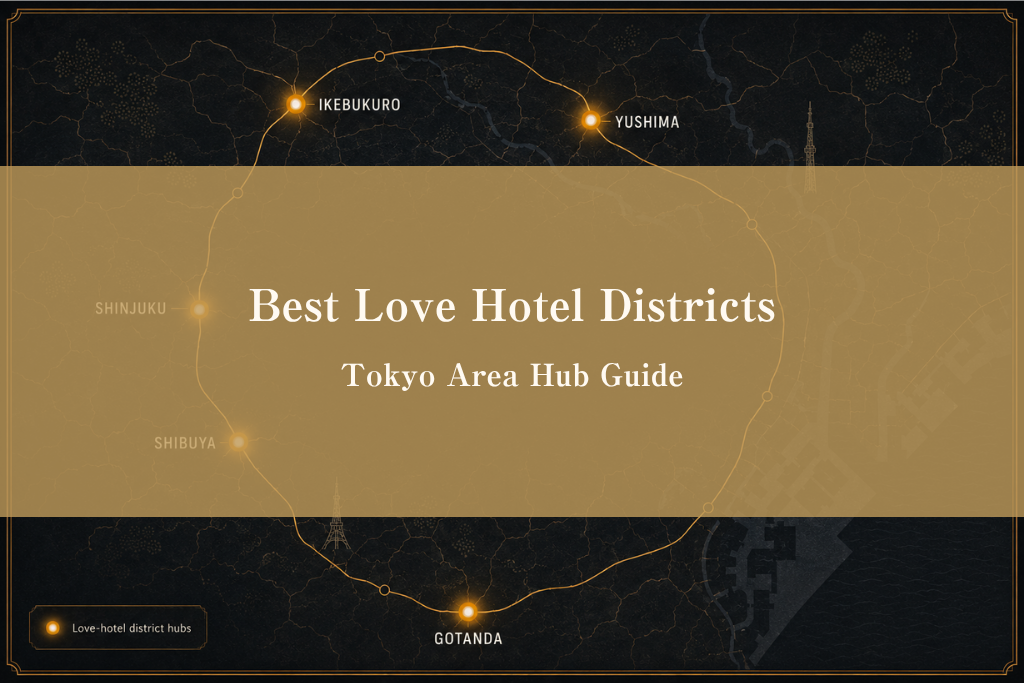
Best Love Hotel Districts in Tokyo | MIRAI TOKYO
Tokyo love-hotel districts explained—Ikebukuro, Shinjuku, Shibuya, Gotanda, Yushima—area guide for foreign guests choosing where to go.
Plan your Tokyo Bay outcall after choosing the right base
Once the area and accommodation conditions are clear, contact the MIRAI TOKYO concierge to check availability and finalize the fee and arrival arrangement.
This content is for informational purposes only and does not constitute legal advice. Accommodation visitor policies, transportation fees, availability, and arrival arrangements may change; confirm current terms directly with the property and MIRAI TOKYO before booking.