










 MIRAI TOKYO concierge team

Your first night in Tokyo can feel unusually important. The city is finally outside your window, the evening is already moving, and it may seem as though you should make those first hours count. But arrival night is not a test of how much Tokyo you can fit in. The better question is simpler: what kind of evening fits the time, energy, and company you actually want after check-in?
This guide helps you choose without turning the night into a fixed itinerary. You might stay close to the hotel, go out for one clear experience, find a social setting, or keep the evening private. None is the universally correct first night. The useful choice is the one that leaves you feeling that the trip has begun without borrowing too much from tomorrow.
Contents
Your First Night Does Not Have to Prove Anything
Tokyo offers more possible nights than any visitor could reasonably compare after a flight. Observation decks, late meals, small bars, clubs, quiet streets, baths, convenience-store discoveries, and a hotel room above the city can all belong to the same place. That abundance is exciting in the planning stage. On arrival, it can become pressure.
The pressure usually comes from treating the first evening as a miniature version of the whole trip. If you do not see a famous crossing, eat somewhere memorable, meet somebody, and stay out late, have you wasted the night? That standard ignores what arrival changes. A delayed train can remove an hour. Hunger can become more urgent than sightseeing. A person who expected to feel exhausted may become alert as soon as they step outside; somebody who planned a long night may discover that they want silence.
A useful first night gives you one clear point of contact with Tokyo: a meal, a view, a conversation, a neighborhood walk, or simply the realization that you are here. It does not have to settle what you think of the city.
Read the Evening You Actually Have
Before choosing a place, read the evening as it exists now. Five questions are more useful than a long list of recommendations.
How much usable time remains?
Look beyond the time on the clock. The usable part of the evening begins after baggage, transport, check-in, and anything you need to do before going out. It ends early enough for you to return without turning the journey back into a problem. Tokyo’s rail services generally do not run through the night, and exact last-train times differ by line and destination. If your plan depends on a train, check the route for that evening rather than relying on a general idea of when Tokyo closes.
What does your body need first?
Hunger, thirst, fatigue, and the wish to shower are not obstacles to a successful night; they are part of the decision. A plan that begins by solving the strongest need often feels better than one that asks you to ignore it. If food is the priority, eat before deciding whether the night should continue. If you need twenty quiet minutes in the room, take them before interpreting tiredness as a final answer.
Do you want the city, company, or privacy?
These desires can overlap, but one is often strongest. Wanting the city means that atmosphere, movement, or a particular sight matters. Wanting company means that conversation or shared attention matters more than the location. Wanting privacy means controlling the pace, noise, and social demands of the evening. Naming the priority prevents you from choosing an impressive plan that supplies the wrong thing.
How much uncertainty feels enjoyable?
Some travelers come alive when they wander without a destination. Others enjoy Tokyo more when transport, venue, and return route are already clear. Neither approach is more adventurous. Decide how many uncertain elements you want tonight. A new neighborhood, an unfamiliar menu, and an open-ended late return may be three pleasures on another day but three burdens after arrival.
What does tomorrow ask of you?
An early reservation, a business meeting, or a full day on foot changes the cost of staying out. So does a free morning. This is not an argument for always sleeping early. Be honest about the trade-off. A late night can be worth it when it is the thing you most want, rather than the result of drifting from one decision to the next.
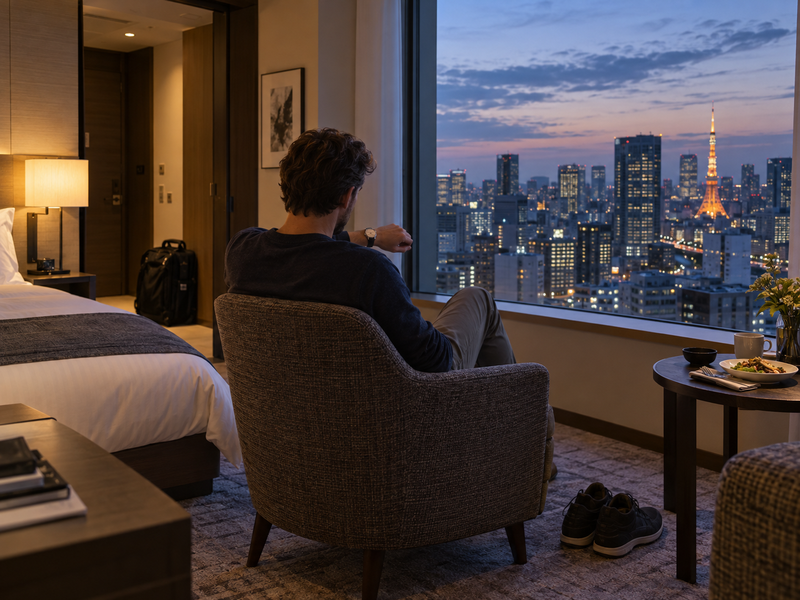
Four Shapes a First Tokyo Evening Can Take
Once those conditions are visible, most first-night ideas have one of four starting points. These are not exclusive categories: a nearby bar can be local and social, while dinner with a friend can be public and social. Use the table to choose the main thing you want the night to provide. Add a second element only if it supports that priority.
| Starting point | Main reward | Movement | Social effort | Condition to settle first |
|---|---|---|---|---|
| Hotel area | Orientation and recovery | Low | Low or optional | Food and walking distance |
| One public experience | A vivid sense of Tokyo | Medium | Optional | Last entry and return route |
| Social night | Conversation and shared energy | Variable | High | Meeting frame and way back |
| Private night | Control over pace and setting | Low | Low to moderate | Desired level of privacy |
1. Let the hotel area be enough
This is not the same as giving up and going to bed. You can eat within easy walking distance, learn where the nearest station and convenience store are, take a short loop through the neighborhood, and return while the route still feels obvious. A ramen counter, a neighborhood izakaya, or food picked up from a depachika before it closes can provide a first encounter with the city without requiring another cross-town journey. The scale is small, but the benefit is concrete: the area around your hotel becomes familiar before you need it in the morning.
This shape fits a late arrival, low energy, uncertain weather, or an early next day. It also works when your mind wants novelty but your body does not want a project. Choose one small point of interest—a local meal, a lit side street, a quiet drink—and let that be the first page rather than a summary of the whole city.
2. Choose one public Tokyo experience
If you want to feel the city immediately, give the night a single anchor. Tokyo-specific possibilities include a timed observation deck, a museum or gallery on one of its late-opening days, an illuminated temple or garden during a seasonal event, a yokocho of compact eating places, or the dense evening streets of Shibuya, Shinjuku, or Roppongi. These experiences ask different things of you: a timed entry rewards certainty, a yokocho asks for more spontaneity, and a nightlife district can extend beyond the last trains.
Build the trip out and back around that anchor. Check opening or last-entry information on the day, identify the return route, and decide what you will skip. You may add something nearby if time and energy remain, but the evening does not depend on it. This approach provides the vivid sense of arrival many people seek without making every transfer part of a race.
3. Make it a social night
Sometimes the missing element is not another view but another voice. A social first night might mean meeting a friend, joining people you already know, choosing a venue where conversation is part of the setting, or attending an activity arranged in advance. The important distinction is that the social environment—not a checklist of attractions—is the main experience.
Think about how much initiative and ambiguity you want. Meeting a known person offers a clearer frame. A standing bar, an izakaya counter, or a compact alley of bars may put you near other people without guaranteeing conversation. Larger clubs in areas such as Shibuya or Roppongi offer more energy but less control over whether a meaningful exchange happens. Language, noise, queues, admission rules, and the trip back can matter more when you are tired.
4. Keep the evening private
A private night can mean being alone with room-service food and a city view. It can mean calling somebody you know, sharing time with a travel partner, or arranging adult company through a service whose terms you have checked. These are distinct choices; privacy is the common feature, not a promise that they provide the same experience.
This shape can suit someone who wants company without another journey across the city, or someone who values control over noise and timing. If you are alone, the main condition may be as simple as deciding what would make the room restorative. With a friend or travel partner, align expectations about the pace of the evening. Only when another visitor or a paid service is involved do hotel access, mutual boundaries, the service scope, and total cost become conditions to settle. Privacy should reduce confusion, not hide it.
For example, a traveler who checks in at 9:30 PM, needs food, has an early morning, and does not want a complicated return route will usually get more from the hotel-area starting point than from crossing the city for nightlife. Someone arriving earlier with high energy, no morning commitment, and a strong wish to see Tokyo after dark might choose one observation point or district, then decide on the way back whether a social stop still sounds appealing. The same five questions produce different answers because the priority changes.
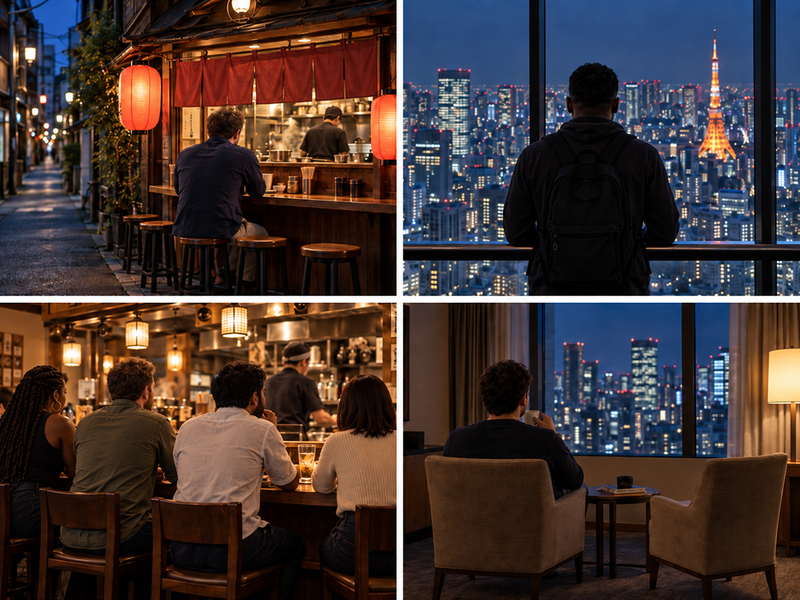
Keep the Flexible Parts Flexible
A first-night plan works better with a firm center and soft edges. If dinner is the center, keep the walk afterward optional. If a view is the center, do not make three other districts prerequisites. If meeting somebody is the center, settle the place and return journey while leaving the length of the evening realistic.
Set one decision point—after check-in, after food, or after a short walk—when you will use your current energy to decide whether to continue. Confirm only the changing condition that could break your chosen plan: last entry for a view, the last useful train home, hotel visitor rules for a private meeting, or another person’s availability. You do not need live information about every branch you have already decided not to take.
If Private Adult Company Is One of Your Options
For some adult visitors, the private starting point raises one more possibility: paid companionship or an outcall adult service. If it is relevant to you, begin by separating what you want—conversation, erotic intimacy, a shared meal or drink, or simply company—from the format being offered.
Evaluate a paid service through what you can verify: what is provided, the course conditions and total fees, hotel access, available communication, and the boundaries of everyone involved. Do not treat a commercial arrangement as a substitute for friendship, romance, or guaranteed chemistry. An idea formed after check-in also does not guarantee that a particular person or time can be arranged.
MIRAI TOKYO publishes time-based courses, companion profiles, and an additional At-Home Drinking Plan for enjoying drinks and meals with a selected companion. Those pages show the formats. They do not decide the night for you. The current structure and conditions are listed on the published pricing page.
What to check before choosing adult outcall
If adult outcall remains among your options, move from atmosphere to verifiable conditions. Safety, hygiene, price transparency, communication, hotel access, and the sequence from inquiry to arrival are covered in MIRAI TOKYO’s separate first-time guide:

Your First Tokyo Outcall? A Step-by-Step Guide for Foreigners (Keep it Safe, Hygienic & Easy)
Your first Tokyo outcall made simple. A clear, step-by-step guide for foreigners covering safety, hygiene, privacy, pricing, and English support—so you can book with confidence and peace of mind.
MIRAI TOKYO’s published guidance recommends contacting the concierge two to three hours ahead and notes that same-day arrangements depend on availability. Current procedures should be checked on the How to Use page. This practical check is a separate decision from choosing whether a private adult service belongs in your first night at all.
Leave Enough of Tokyo for Tomorrow
Read the time and energy you have, decide what you want the evening to provide, and choose one starting point. Make its essential condition firm—food nearby, a last entry, a meeting frame, or clear private boundaries—and leave everything else optional. A first night does not need every version of Tokyo. It needs a choice that still feels right when morning arrives.
About the Publisher of This Guide
MIRAI TOKYO is an outcall adult-companion service based in Roppongi, sending companions to guests’ hotel rooms in Tokyo. The service publishes English-language information about its formats and contact process.

This content is for informational purposes only and does not constitute legal advice. Transport schedules, venue hours, hotel visitor policies, service conditions, fees, and availability can change; confirm the current terms that apply to the evening you choose.