











 MIRAI TOKYO concierge team
If you are staying at a Shibuya hotel and searching for a Shibuya outcall in Tokyo, the practical answer is yes: a premium companion can be dispatched to your hotel room or suitable private room in and around Shibuya, with English-language booking from start to finish. The part most foreign guests get wrong is the geography. “Shibuya” stretches from the station-connected towers above the scramble crossing to quieter hotel pockets around its edges, including boundary areas such as Aoyama as well as Daikanyama and Ebisu—and it is a different location problem from the love-hotel back streets the district is also known for. This guide maps Shibuya’s neighborhoods, the hotel types that suit a discreet arrival, how to reach the area from the airport, how dispatch works to your room, and how transportation fees are framed when your hotel sits in Shibuya Ward rather than the free Minato Ward zone.
The essentials for a Shibuya outcall: your companion comes to your own hotel room or suitable private room, not a love hotel or a shop. Shibuya is Shibuya Ward—just west of MIRAI TOKYO’s Minato base, so dispatch distance is short, though a modest transportation fee applies because it sits outside the free Minato zone. Booking, arrival etiquette, and support are handled in English. Confirm your specific hotel address with the concierge before you book.
Table of Contents
Why Book an Outcall to a Shibuya Hotel
Outcall means the companion travels to you. For a Shibuya stay, that means she arrives at the hotel room or suitable private room you have already checked into—a city hotel above the station, a design property near Aoyama, a boutique stay in Daikanyama—rather than you navigating a shop or a love-hotel entrance. That distinction is the whole reason the format suits a visiting gentleman: you stay in your own space, on your own schedule, in a hotel you chose.
Shibuya works well for this because it is a hub, not a corner. It is one of Tokyo’s primary rail interchanges and a natural base for a trip that mixes business meetings, shopping, and nightlife. Many international visitors end up with a Shibuya-side hotel simply because it connects to everywhere else. Once you are anchored there, dispatch to your room removes the need to travel again at the end of the evening.
One clarification up front, because the word “Shibuya” carries two meanings in this context. Shibuya is also a well-known love-hotel district, with pockets of short-stay properties on the back streets off Dogenzaka. That is a different product from booking a verified companion to your own hotel room or suitable private room. If your question is about love-hotel geography rather than premium room-based outcall, use the Tokyo love-hotel districts hub below. This article stays with the hotel-room case.
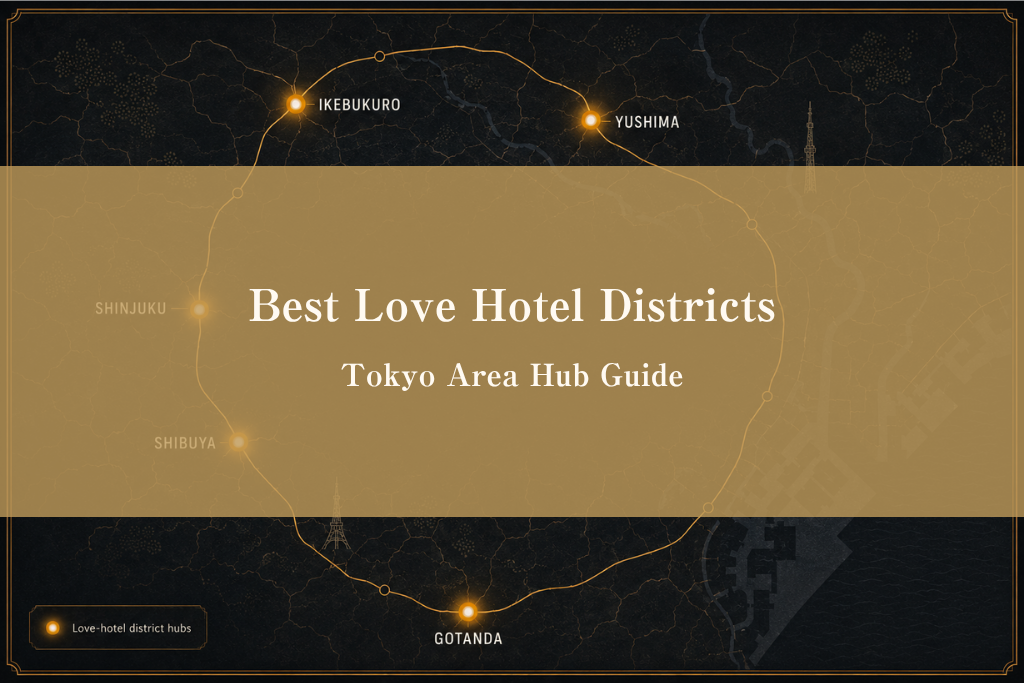
Best Love Hotel Districts in Tokyo | MIRAI TOKYO
Tokyo love-hotel districts explained—Ikebukuro, Shinjuku, Shibuya, Gotanda, Yushima—area guide for foreign guests choosing where to go.
Shibuya’s Neighborhoods and Where Guests Stay
“Shibuya” on a booking form usually means Shibuya Ward, which is larger and more varied than the scramble crossing most visitors picture. Where your hotel actually sits changes the feel of the arrival more than the mechanics of it. Here is how the sub-districts break down for someone staying in the area.

Shibuya Station core
The area directly around the station has been rebuilt over the past several years into a cluster of high-rise complexes, and several new hotels sit inside or beside those towers. This is the most connected place to stay and the busiest. For an arrival, the trade-off is scale: large, well-staffed lobbies and multiple elevator banks tend to absorb ordinary guest traffic without anyone standing out.
Dogenzaka, Maruyamacho and Sakuragaoka
West of the station the ground rises. Dogenzaka and adjacent Maruyamacho carry the nightlife-and-club energy Shibuya is known for after dark, and this is also where the love-hotel pockets sit—worth knowing so you can tell the two products apart. Just south, Sakuragaoka has been redeveloped into a calmer, more business-leaning quarter, a noticeable step down in street noise from the crossing.
Jinnan and Udagawacho
North of the crossing, around Center Gai, Jinnan and Udagawacho are youth-fashion and retail territory—lively, crowded, and central. Accommodation here skews toward smaller and mid-range properties. It is convenient, but the least discreet part of the ward simply because of the foot traffic.
Aoyama, Omotesando, Daikanyama and Ebisu
The refined areas along Shibuya’s edges are where many premium travelers actually stay. Aoyama and Omotesando run to upscale, design-led hotels—though note they straddle the Shibuya–Minato boundary, so a hotel there may actually sit in Minato Ward; Daikanyama and Ebisu are lower-key, residential in feel, and squarely in Shibuya Ward. These pockets tend to offer the calmest arrivals, and they are still only a few minutes from Shibuya Station by train or car. Because the transportation fee is set by your hotel’s ward, confirm the exact address with the concierge—an Aoyama or Omotesando hotel may fall in the free Minato zone.
Hotel Tendencies in Shibuya
Shibuya does not have a single hotel type. It has three broad tendencies, and the right one for you depends as much on how you value a discreet arrival as on room quality. Rather than name specific properties—availability and policies change, and no single hotel is “the” outcall hotel—it is more useful to read the categories.

Station-connected towers
The newer high-rise hotels above and beside the station offer the strongest access and, generally, the smoothest arrivals. Large lobbies, several elevator banks, and steady international guest flow mean a companion arriving to meet a guest reads as ordinary hotel traffic. These properties tend to sit at the higher end on price.
Design and boutique hotels
Aoyama, Daikanyama, and the streets around Omotesando hold smaller design-led hotels. They are quieter and more personal, which some guests prefer. The counterpoint is scale: a compact lobby and a single elevator core mean arrival timing and dress matter a little more than they do in a large tower. Nothing prohibitive—just worth planning.
Business and mid-range hotels
Shibuya has a deep supply of business and mid-range hotels, especially north of the station. Policies vary widely property to property; some are entirely used to guests receiving visitors, others less so. If your room is a shared or standard business room, it is worth confirming that the space suits a private visit before you book. This is one case where a larger, more anonymous property can be the more comfortable choice.
Across all three, the things that actually help a discreet arrival are the same: enough lobby scale to be unremarkable, direct elevator access to guest floors, and a front-desk culture that does not phone rooms about visitors. You do not need to interrogate a hotel about this—the concierge handling your booking can advise on arrival approach for the type of property you are in.
Getting to Shibuya: Rail Hub and Airport Access
Part of why Shibuya suits an outcall stay is that getting there—and getting the day started—is easy. Shibuya Station is served by more than eight rail and subway lines, including the JR Yamanote loop, the Saikyo and Shonan-Shinjuku lines, the Tokyo Metro Ginza, Hanzomon, and Fukutoshin lines, the Tokyu Toyoko and Den-en-toshi lines, and the Keio Inokashira line. The Fukutoshin line in particular links Shibuya directly to Shinjuku-sanchome, Ikebukuro, and, through cross-service, toward Yokohama—useful if your itinerary is spread across the city.

From Narita Airport, two routes reach the Shibuya area directly. The Narita Express (N’EX) runs to Shibuya Station, and the Airport Limousine Bus serves several Shibuya-area hotels, dropping you close to your room after a long flight. From Haneda Airport, Shibuya is a shorter hop by train via the Tokyu and Keikyu networks, or by limousine bus. In practice, many guests arrive, check in, settle, and only then think about the evening—which is exactly the sequence an outcall is built for.
Because Shibuya connects so cleanly to the rest of central Tokyo, it also sits close to MIRAI TOKYO’s core service area around Roppongi and Minato. That proximity matters for dispatch, which the next section covers.
How Dispatch and Arrival Work at a Shibuya Hotel
The booking itself is straightforward and runs in English. You reach the concierge through your preferred channel—LINE, WhatsApp, WeChat, Instagram, KakaoTalk, or the web form—choose a companion from the published profiles, and confirm your hotel, room readiness, and timing. Booking two to three hours ahead is recommended; same-night requests are considered when companion schedules allow. Operating hours run from 10:00 to 06:00 the next day, which covers late dinners, post-flight arrivals, and Shibuya’s own late nightlife. For the full step-by-step, see how to book.
Arrival at a city hotel is treated as part of the service rather than left to chance. That means sensible timing, dress appropriate to the property, going directly to the room rather than lingering in public areas, and not routing contact through the hotel’s front desk or house phones. In a large station tower this is almost automatic; in a small design hotel it is handled with a little more care. The concierge can advise based on your property type.
On transportation fees, the honest framing is geographic. MIRAI TOKYO calculates travel by ward, and Shibuya is Shibuya Ward—just outside the free Minato Ward zone. In plain terms, a modest transportation fee typically applies to a Shibuya address, but the distance from the Roppongi and Minato base is short, so this is a near dispatch rather than a long cross-city one. Rather than quote a figure that may change, confirm the current amount on the pricing page. For how coverage and travel fees work ward by ward across the city, see the related guides below.
Tokyo Outcall Coverage & Areas | MIRAI TOKYO
Where can outcall reach in Tokyo? Travel time, area fees, hotel rules, and how to ask for coverage and arrival windows with clarity.
Roppongi & Minato Outcall: Area, Hotels & Dispatch Guide
How outcall works in Roppongi and Minato: hotel types, serviced apartments, love-hotel differences, dispatch flow, and Minato coverage fees.
Booking a Shibuya Outcall with MIRAI TOKYO
MIRAI TOKYO is a non-storefront premium outcall service based in Roppongi and built for international visitors staying at luxury hotels across central Tokyo, Shibuya included. What makes it workable for a foreign guest in Shibuya is the same structure it applies everywhere, read against a specific address:
- Rank-based, published pricing: SILVER, GOLD, PLATINUM, and DIAMOND tiers with course prices shown in full for 60 to 180 minutes, plus a non-public ASK tier. No “from ¥XX” ambiguity.
- Transparent fee items: photo selection and repeat nomination fees are listed publicly, joining is free of any membership fee, and transportation is stated by ward on the pricing page.
- English across every channel: LINE, WhatsApp, WeChat, Instagram, KakaoTalk, and a web form—before, during, and after the booking.
- Published rules: the public guidance sets out what is not accepted (no minors, no full service, no photography, no drugs, no intoxicated clients, no guests with STIs, no multiple-person sessions, no violence), so the terms are legible before you contact anyone.
- Short dispatch to Shibuya: the Roppongi base is close to Shibuya Ward, which keeps arrival timing predictable even for a same-evening request.
None of this is unique to Shibuya. What is specific to Shibuya is the pairing: a well-connected ward full of city hotels, a base a few minutes away, and a booking process that treats your particular hotel—its lobby, its arrival flow, its ward-based travel fee—as the thing to get right.
FAQ
Summary
If you are Shibuya-based, your next steps are short. Confirm which pocket your hotel is in—station tower, hillside quarter, Aoyama or Omotesando boundary area, or the calmer Daikanyama–Ebisu edge—since that shapes the arrival more than anything else. Note that fees are ward-based, so check the current amount on the pricing page rather than assuming either the free-Minato rate or the Shibuya rate. Then message the concierge in your preferred language with your hotel and timing. The rail hub gets you around the city; the outcall brings the evening back to your own room.
Premium Outcall to Your Shibuya Hotel
MIRAI TOKYO dispatches verified companions to luxury city hotels across Shibuya and central Tokyo, with English support on every channel and pricing published in full. Confirm your hotel and timing with the concierge.
This content is for informational purposes only and does not constitute legal advice. It describes adult-companion booking conventions and area logistics for Shibuya. Individual hotel policies, pricing, and transportation fees may change; always confirm current terms and your specific hotel address directly with the operator before booking.