










 MIRAI TOKYO concierge team

The short answer: Some deriheru businesses in Tokyo do turn away foreign customers, and a few say so in their published terms. Many others accept international customers, and MIRAI TOKYO is one of them. You can usually tell the difference before you book: Does the shop publish its rules and prices in English, and can someone answer you in English on an app you already use?
Deriheru, short for “delivery health,” is Japan’s outcall format. There is no venue to visit; the companion comes to your hotel room. That makes your first message the only way in. If you are in Tokyo for a few days and wondering whether that door is open to you, the sections below explain why some shops keep it closed, what an open one looks like, and what booking with us actually involves.
Why some shops say no to foreign guests
These refusals are real. One delivery health business in the Tokyo area lists foreign customers among the people it will not serve, directly in its public terms. It does not explain why.
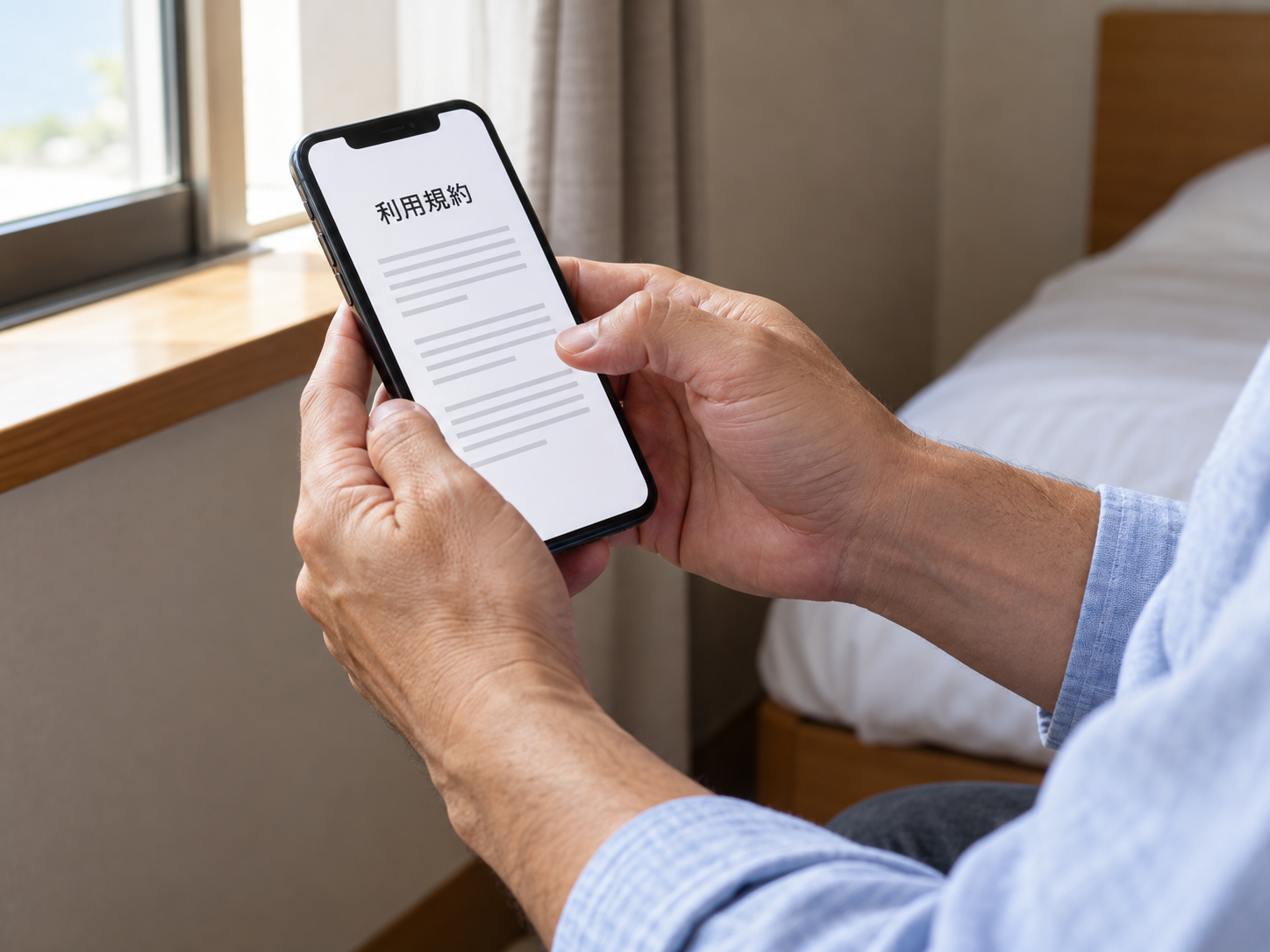
Where reasons have been given, they tend to be about language rather than nationality itself. In a December 2022 interview with the Japanese magazine FRIDAY Digital, two people who said they had worked in delivery health explained that they declined foreign customers because they could not explain in detail what they would not do when the customer did not understand Japanese.
That is a narrower concern than it first sounds. Small talk was not the issue; a smile and a few phrases are enough for a greeting. What they could not be sure of was whether a specific limit had actually been understood. In a private, one-on-one service, that matters more than a pleasant atmosphere.
Two caveats keep this in perspective. An interview with two people in 2022 is not a survey of how shops operate today. And a rule based on nationality is not the same as a language requirement: It would turn away a fluent Japanese speaker too, and it gives no reason at all. Encountering such a rule is frustrating, but it reflects one business’s policy, not a judgment about you or about how Tokyo treats visitors.
How to tell whether a shop will take your booking
Since there is no reception desk to visit, a shop’s website and messaging channels are where you find out. A few signs answer the question quickly:
- It says so in writing: A shop that accepts international customers usually states this clearly, instead of leaving you to guess from a machine-translated page.
- The rules are readable before you book: If the difficulty described in that interview is real, the solution is to publish the limits in a language you can read in advance, not to explain them after someone has arrived.
- Someone replies in English: An English form means little if the reply comes back in Japanese. Look for a clear point of contact and channels you already use while traveling.
- Prices and fees are published: Rates, how they are structured, and any travel fees should be on a page you can read, not revealed after you have chosen a time.
- The service area is stated: Outcall depends on where you are staying, so the shop should state which areas and hotels it covers.
None of these signs promises more than it says. Taken together, though, they show whether a shop has actually prepared for customers who do not speak Japanese, or has simply not ruled them out.
How MIRAI TOKYO Serves International Customers
MIRAI TOKYO is a delivery health service based in Roppongi, in Tokyo’s Minato City, and we accept foreign customers. We are not an inbound-only business. Many of our customers are Japanese, and visitors from abroad book the same service, with the same companions and the same rules.
What we have done is remove the language barrier from the booking process itself:
- An English-speaking concierge handles inquiries, so you can ask about availability, companions, or your hotel in English.
- You can reach us on LINE, WhatsApp, WeChat, Instagram, or KakaoTalk, or through the web form on our English site.
- Our rates are published in English on the pricing page, organized into SILVER, GOLD, PLATINUM, and DIAMOND ranks, plus an unpublished ASK rank.
- Our rules are published in English on the How to Use page, so you can read them before you send a message.
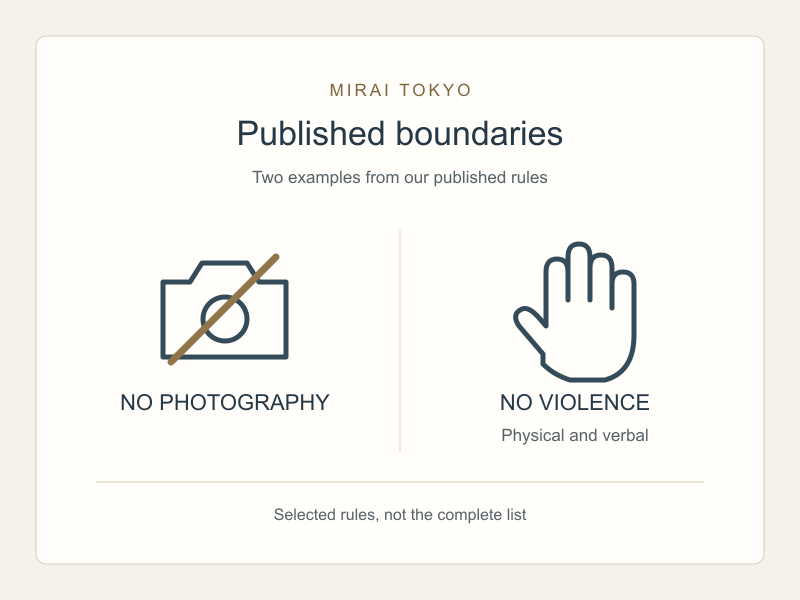
The rules are short and specific: no photography, no physical or verbal violence, no drugs, no intoxicated customers, and no full service, among others. Publishing them in English is our answer to the concern raised in that 2022 interview. A companion does not have to negotiate her limits in a second language after she arrives, because you have already read them. Our Japanese-language pricing page states the consequence clearly: If a customer presses for or tries to negotiate full service, the session will be ended without a refund.
What to expect when you book with us
Companions come to you: We have no shop, lounge, or front desk. Companions visit customers’ rooms at upscale hotels in central Tokyo, including Roppongi, Ginza, Shibuya, and Akasaka.
Timing: Our business hours are from 10:00 until 06:00 the next morning. Contacting us two to three hours in advance is best, but same-day requests are worth asking about.
Travel fees: There is no travel fee within Minato City. Other wards are charged by area, as listed on the pricing page, and locations outside the 23 wards or in neighboring prefectures are arranged case by case.
Who you will meet: Every companion has been confirmed to be 20 or older and works with us by her own choice.
If another shop has turned you down, remember that one business’s rule does not represent the whole city. What you want is a service that tells you, in a language you can read, who it serves, what it costs, and what it expects, and someone who can answer in English when you ask.
About MIRAI TOKYO
MIRAI TOKYO is a Roppongi-based delivery health service that sends companions to hotels in central Tokyo. Our rules, rates, and booking steps are published in English, and our concierge can answer your questions in English before you decide.
 Read the Service Guide in English
This article provides general background information, not legal advice or a statement of any business’s complete conditions. The interview cited was published in 2022 and is not a survey of current industry practices.