










 MIRAI TOKYO concierge team

If you are staying in Tokyo and wondering whether to contact an “independent companion” or go through an agency, here is the short answer: In Japan, these words describe how a service advertises itself, not how the law classifies it. The law looks at the business behind the visit. A business that sends companions to hotel rooms is a non-storefront adult business, and it must file a notification with the Public Safety Commission before it opens. MIRAI TOKYO, based in Roppongi, is one of these businesses. Here is what that means for you as a customer, and what to look for before anyone knocks on your hotel door.
Independent or Agency: What You Are Really Choosing
When a profile says “independent,” it usually refers to a woman who presents herself and answers messages without an agency. You will also see “independent escort” on English pages. “Agency” usually means a business that takes your inquiry and sends a companion to you. Both terms describe who you communicate with; neither is a category in Japan’s adult-business law.
This matters because the label alone tells you very little. A business may be run by one person rather than a company, and a profile written in the first person does not show who handles bookings and payment behind it. Tokyo Metropolitan Police Department guidance reflects this: The notification rules list the documents required for an individual filing, plus additional documents when the business is a corporation. So “independent” does not automatically mean illegal, and it does not mean exempt from the rules either.
What you are really choosing is a style of contact. Some customers like messaging one person directly. Others prefer a dedicated contact who handles the details, so their time with a companion is just that. Either preference is reasonable. The more useful question is which business stands behind the visit and whether it tells you, clearly and in advance, what to expect.
At MIRAI TOKYO, the answer is simple. You deal directly with the business through an English-speaking concierge. Every companion is confirmed to be 20 or older and works by her own choice.
“Call girl” is another English term that is used loosely in Japan; this guide explains what it means locally.

What Does “Call Girl” Mean in Japan? From the English Term to Deriheru | MIRAI TOKYO Roppongi | Luxury Escort Club in Tokyo
If you typed “call girl Japan” into a search bar, here is the short answer: Japan has no legal “call girl” business. In English, a call girl is a woman who sell...
The Rule Behind Every Hotel Visit
Japan’s Act on Control and Improvement of Amusement Business, etc., known as the Fūeihō, covers businesses that send someone to a customer’s residence or hotel to provide specified intimate-contact services. In Japanese, this is called deriheru (delivery health), and the legal term is a non-storefront business. “Non-storefront” simply means there is no shop for customers to visit. It does not mean unregulated.

The obligations lie with the business, not with you. In outline:
- The business files with the Public Safety Commission for the area of its principal office, through the local police station. For a Tokyo-based business, that is the Tokyo Metropolitan Public Safety Commission.
- It must file before it starts operating, at least ten days in advance.
- The filing records who runs the business, the names it advertises under, its office location, how it receives customer requests, and its contact details.
Your hotel’s address plays no role in this. Whether you are staying in Ginza or Shibuya, the filing depends on where the business is based.
English pages often describe such a business as “licensed.” For a non-storefront business, what that word refers to under Japanese law is this notification to the Public Safety Commission. When MIRAI TOKYO describes itself as a licensed delivery health service, this is the system it is referring to.
If you are still working out how delivery health differs from hotel outcall or storefront shops, these two guides compare the formats side by side.

Deriheru vs. Hotel Premium Outcall in Tokyo: Dispatch Rules, Privacy & Foreign-Friendly Booking | MIRAI TOKYO Roppongi | Luxury Escort Club in Tokyo
Deriheru and hotel premium outcall share Japan's non-storefront legal category. Their service design does not. Legal frame, industry glossary, and MIRAI TOKYO's structure explained.

Deriheru vs. Fashion Health vs. Hotel Health in Tokyo: Three Formats Foreign Guests Mix Up | MIRAI TOKYO Roppongi | Luxury Escort Club in Tokyo
Deriheru, fashion health, hotel health: three Tokyo adult-service formats that look alike but work very differently. History, legal frames, pricing, and foreign-visitor fit explained.
What a Notification Tells You, and What It Doesn’t
Once a filing is accepted, the commission issues a todokede kakuninsho (届出確認書), or notification confirmation document. Under the Act, the business must keep it at its office and be able to present it when an interested party asks. Because an outcall business has no front desk, published police guidance also allows it to be presented in other ways, such as by showing a copy.

It helps to be realistic about what this paperwork does for you:
- It shows that a filing was made. It does not rate service quality, and it is not a government endorsement.
- A trading name may differ from the registered name. The law expects businesses to list the names they advertise under, so a different brand name is normal.
- A number on a website is not a live check, and the absence of one on an English page does not prove that a business has not filed. There is no public English-language directory you can search.
- It does not cover everything. Japan’s Anti-Prostitution Act is a separate law, and a notification does not make anything it prohibits acceptable.
In other words, the notification shows whether a business is operating within the system. It says nothing about what your evening will involve. That depends on what the business tells you before you book.
Is Prostitution Legal in Japan? The Anti-Prostitution Act and the 2026 Review | MIRAI TOKYO Roppongi | Luxury Escort Club in Tokyo
You are in Tokyo, you have seen that adult services openly exist, and you have also read that prostitution is illegal in Japan. So if you book a companion to yo...

Is Adult Massage Legal in Tokyo? Why Professional Standards (Hygiene &Privacy) Are Key
Is adult massage legal in Tokyo? How hygiene, privacy and professional standards define safe, legitimate in-room therapeutic services for visitors.
What You Should Know Before a Companion Arrives
Whichever kind of service you contact, the questions that affect your stay are practical ones. What does the price include? Are there travel fees to your hotel? What is and is not part of the service? And can someone explain all of this in a language you are comfortable with?
Good answers are written down before you book, not improvised once a companion is at the door. A published price list lets you check a quote. Written rules prevent awkward surprises. A clearly named contact gives you someone to ask when something is unclear. These tell you far more than any number of glowing adjectives.
This is where the choice between an independent companion and an agency comes back in. If you message one person directly, check whether the terms are actually spelled out. If you go through a business, check what its contact can explain. No label guarantees a better or safer experience on its own; clear terms do much more of that work.
If you want to spot misleading English listings, our guide to “massage” and “happy ending” wording covers the most common warning signs.
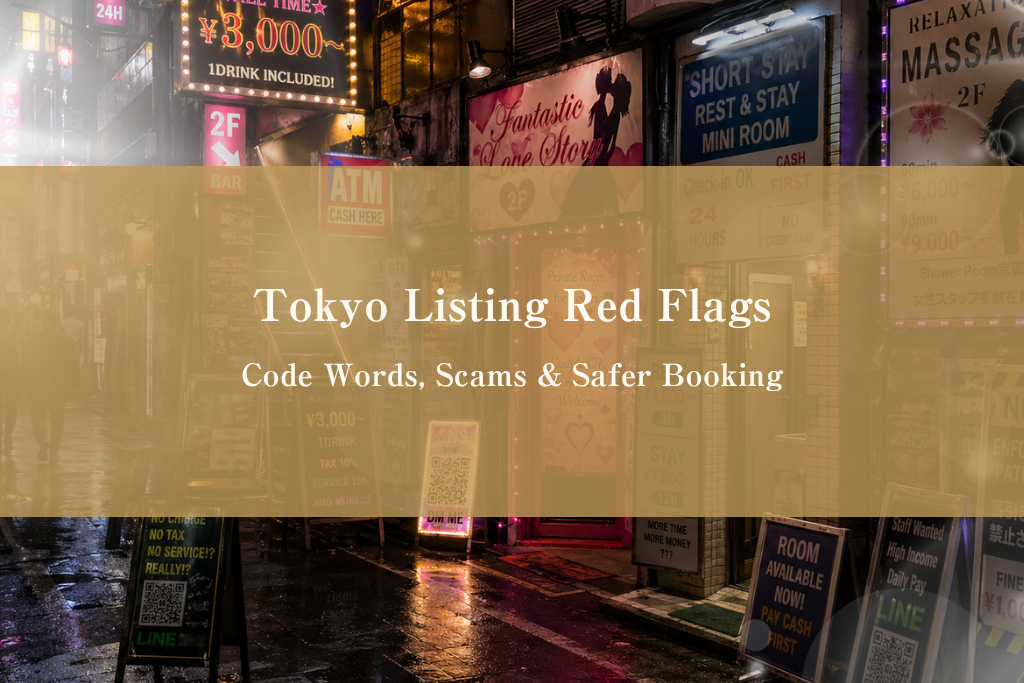
Decoding English “Massage” & “Happy Ending” Listings in Tokyo: Code Words, Red Flags & Safer Booking | MIRAI TOKYO Roppongi | Luxury Escort Club in Tokyo
Decoding Tokyo English massage and happy ending listings. Code words, red flags, green signals, four Kabukicho scam patterns, official warnings, and a ten-item safer booking checklist.
If You Book with MIRAI TOKYO
MIRAI TOKYO is a non-storefront delivery health service in Roppongi, Minato City. There is no shop or lounge; companions visit you at your hotel. The service covers luxury hotels in central Tokyo, including Roppongi, Ginza, Shibuya, and Akasaka. Many of our customers are Japanese, and international visitors are assisted by an English-speaking concierge.
Here is what you can check before you decide:
- Prices, in English: The pricing page explains the companion ranks (SILVER, GOLD, PLATINUM, and DIAMOND, plus an unlisted ASK rank), course fees, and transportation fees. Travel within Minato City is free; fees for other wards are listed by area.
- Rules, in English: The RULES & REGULATIONS section of the booking guide sets age requirements for customers, prohibits photography and violence, and states “NO FULL SERVICE.” If a customer negotiates for or demands it, the session will be ended without a refund.
- The companions: Profiles are available on the companion page. Every companion is confirmed to be 20 or older and works by her own choice.
- Contact and timing: The concierge can be reached by LINE, WhatsApp, WeChat, Instagram, KakaoTalk, or an English web form from 10:00 to 06:00 the next morning. Booking two to three hours in advance is recommended, and same-day requests can be discussed.
If you want to know exactly who you are dealing with and what the visit includes, MIRAI TOKYO provides that information before you book.
Curious how an in-room visit compares with visiting a storefront shop? This guide covers privacy, hygiene, and comfort.
Tokyo Outcall vs. Storefront: Why In-Room Service is Safer, More Discreet & Hygienic
Choosing between a Tokyo storefront and an in-room outcall? Discover the safety, discretion, and hygiene advantages of booking a professional in-room service at your hotel.
About MIRAI TOKYO
MIRAI TOKYO is a non-storefront delivery health service based in Roppongi, Tokyo, that sends adult Japanese companions to customers’ hotel rooms. Prices and rules are published in English, and the concierge can answer your questions in English before you book.
 Published Service Guide
This content is for informational purposes only and does not constitute legal advice. It explains Japan’s outcall business notification framework, not a legal determination about an individual provider or a guarantee of service quality.