











 MIRAI TOKYO concierge team
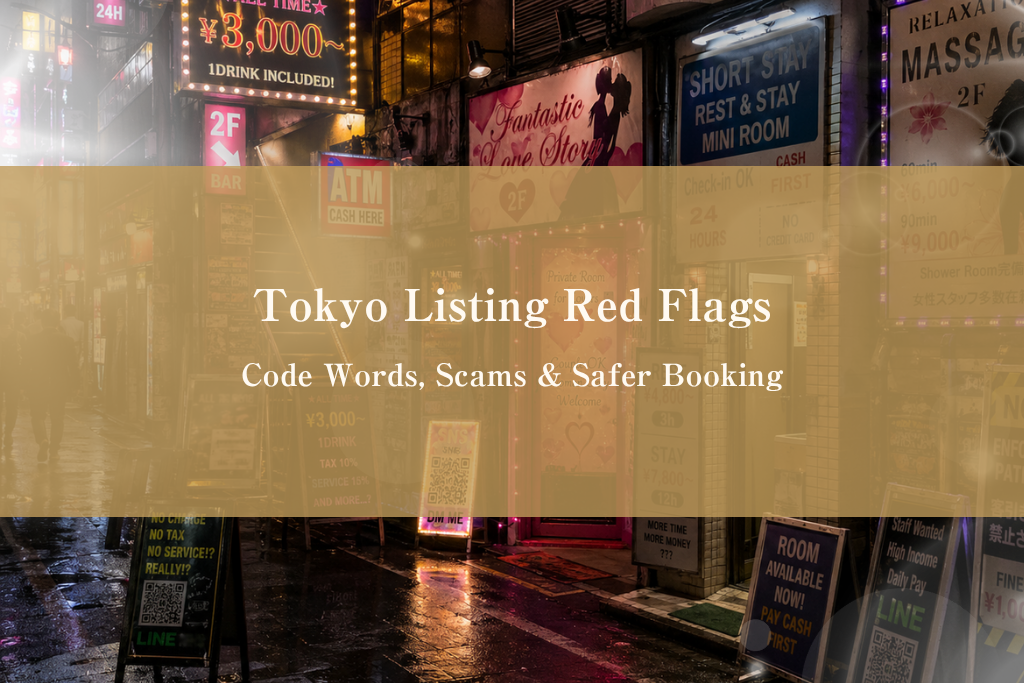
Tokyo’s English-language adult-service advertising spans a wide range. Some of it comes from notified, transparent operators; some of it comes from the unlicensed or gray-area end of the market, where the advertised service may not match what is actually provided. A foreign visitor scrolling through “massage Tokyo,” “happy ending Tokyo,” or “outcall Tokyo” results sees these different categories intermingled without a native marker for which is which. This guide is a literacy tool. It decodes common code words, lists red flags that correlate with risk, summarizes the Kabukicho scam patterns covered by public warnings from Tokyo police and the US State Department, and gives you a safer-booking checklist you can apply in five minutes before any commitment.
Table of Contents
Why English Listings in Tokyo Can Be Misleading
English-language adult advertising in Tokyo has three structural features that can make it hard to read. First, the vocabulary is borrowed—terms like “happy ending” and “outcall” carry US-market meanings that don’t always apply in Japan. Second, the licensing layer is invisible: a reader cannot tell from the English copy alone whether the operator has filed the non-storefront sex-entertainment notification required under the Amusement Business Act (風営法). Third, certain districts (Kabukicho among them) contain higher concentrations of aggressive English-forward advertising, where public reporting has documented risk patterns worth knowing. Reading well means knowing which code words might belong to which category, and which ad patterns are common warning signs.
Code Word Glossary
Common terms you will encounter in English-language Tokyo listings, with their general meaning and Tokyo-specific caveat:
- massage: Can refer to regular licensed bodywork or to unlicensed adult operations—the word alone doesn’t distinguish. The rest of the ad does.
- sensual / adult massage: Sexual element implied. Often associated with unlicensed or gray-area listings. Notified Japanese adult-service operators typically do not brand themselves this way.
- happy ending: Western slang for a massage ending in a sexual act. In Tokyo search results, it is not used as a primary service term by notified Japanese operators and tends to appear in higher-risk listings.
- body-to-body (B2B): A contact-massage framing often associated with men’s esthetic (メンズエステ). In practice, men’s esthetic is usually marketed as a non-sexual relaxation category rather than an adult-business notification category, and listings in this space can blur that boundary.
- nuru massage: Japanese-origin term for a lotion-based full-body service. In Tokyo the term appears mostly in foreign-facing aggregator ads; the category boundaries are fuzzy.
- outcall: Dispatch-based service. In Japan this corresponds to licensed deriheru (無店舗型性風俗特殊営業). Not all English-language “outcall” ads are from licensed deriheru operators.
- incall: The customer visits the venue. Corresponds to storefront categories (fashion health, hotel health, soapland, imekura).
- VIP girl / VIP escort / premium service: Marketing framing. Does not map to any licensing tier. Often used in aggregator ads and Instagram-origin funnels, many of which are scam front-ends.
- all included / all-inclusive: Legitimate usage exists (some operators do publish a fully-inclusive rate). Common red-flag usage is “all included” without a clear written total.
- free option: “Free option” can mean a complimentary upgrade (legitimate). “フリー” (Japanese borrowing, occasionally translated as “free”) means shop-selected companion—no designation fee, but the course price is unchanged.
Red Flags in Listings
Pricing-related red flags
- Rates quoted only as “from ¥XX” with no full breakdown available before booking.
- Transportation, extension, or cancellation fees not published.
- Rank tiers without matching prices, or course durations without matching prices.
- “All inclusive” claim with no itemization when asked.
- Pricing that changes between the website and the confirmation message.
Booking-channel red flags
- No official website, or a website that is a single page with no pricing, rules, or company identity.
- SNS-only booking (LINE, Telegram, Instagram DM) with no alternative channel.
- Demand for advance payment (bank transfer, cryptocurrency, prepaid card) before the hotel name is known.
- Contact information that changes between inquiries (different LINE IDs, phone numbers).
- Pressure to commit before pricing is confirmed in writing.
Photo and profile red flags
- The same photo appearing on multiple independent operator sites.
- Obvious over-editing (panemaji pattern) where profile photos look generated or filter-heavy.
- AI-sounding or template-style companion biographies.
- “Guaranteed,” “the best,” “best in Japan” language repeated throughout.
On-street red flags
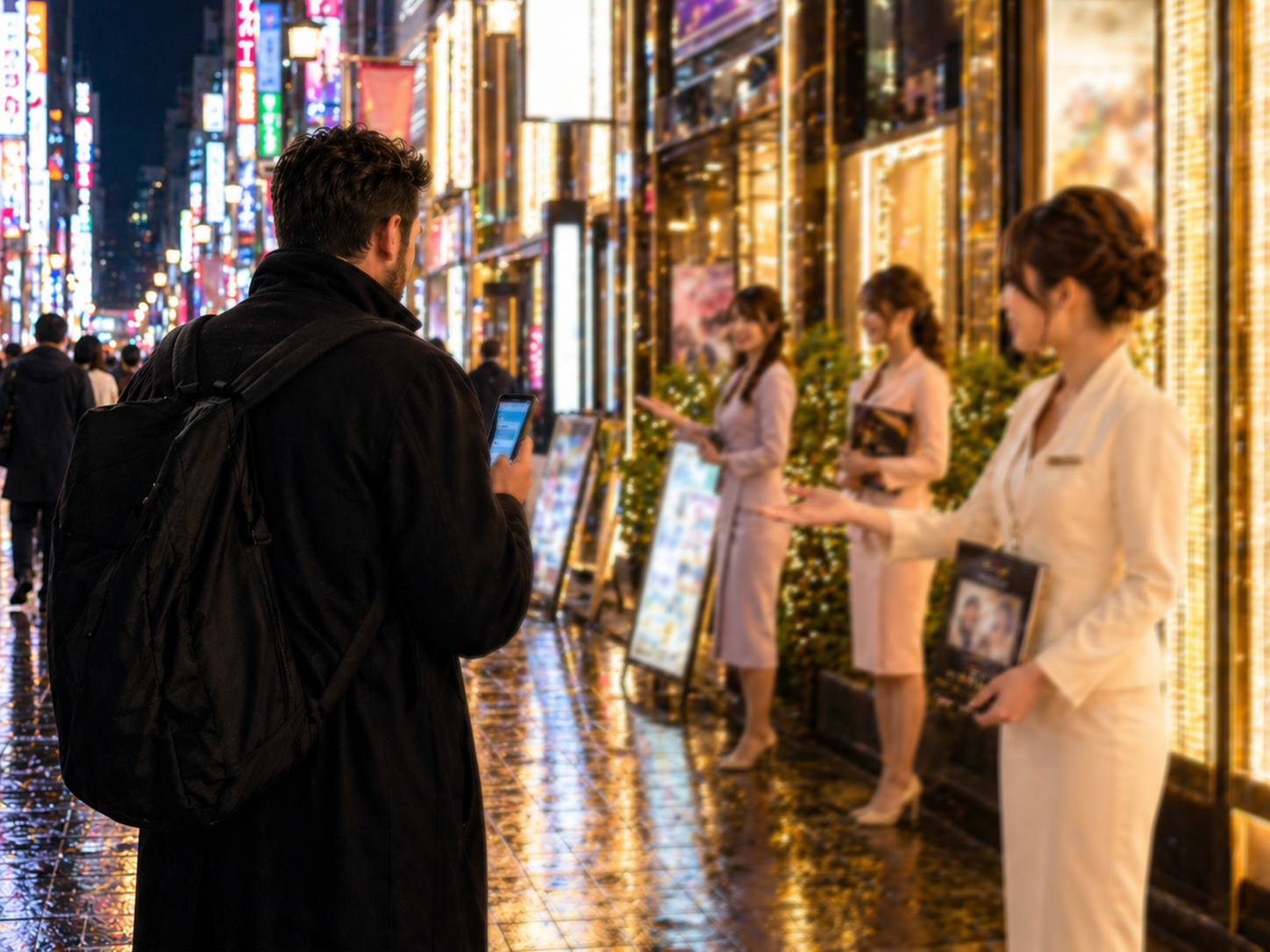
- Street touts (kyakuhiki) directing you to “a good place”—illegal under local Tokyo ordinances in most entertainment districts, but common in Kabukicho.
- Friendly strangers inviting you to drinks or massage in the district.
- “English OK” or “foreigner-friendly” as the most prominent sign feature—legitimate operators rarely foreground this on storefront signage.
- Insistence on visiting the venue before pricing is explained.
Green Signals
The inverse of each red flag is a green signal. These correlate with licensed, transparent operators:
- Full price page with rank × duration × transportation × extension × cancellation all published.
- Operating hours, business days, and cancellation policy explicitly stated.
- House rules (what is not accepted) explicitly stated on the website. Transparency about what the operator declines is a stronger quality signal than marketing language about what it provides.
- Multiple official contact channels—a real phone, a real email, multiple messaging apps, a web form—all pointing to the same identity.
- Named company, published office address, consistent contact information across channels.
- Hotel name requested before pricing is finalized—reasonable operators cannot quote transportation and sometimes total without knowing the location.
- Payment at or after arrival, not pre-payment before dispatch.
- Verified in-house profile photography, with consistent visual language across profiles.
- No street touts directing you to the operator.
Four Scam Patterns in Kabukicho
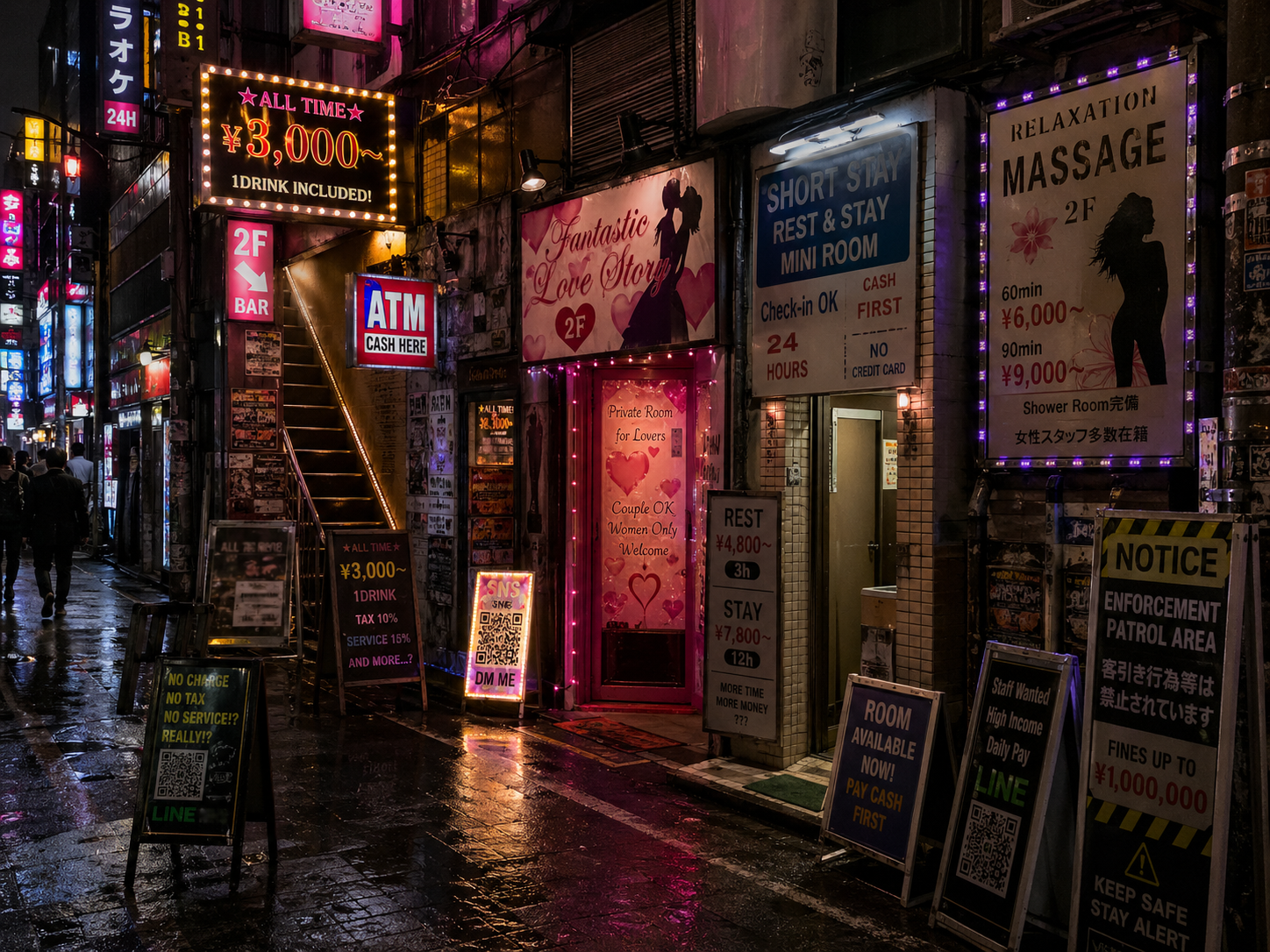
Public reporting has documented four recurring scam structures associated with English-forward advertising in parts of Kabukicho, Shinjuku. Not every English listing in the district fits these patterns, but recognizing each one’s entry point is the practical difference between a safe evening and a bad one.
Pattern A: Bottakuri bar with ATM escort
Entry: Street tout approaches with “English OK / cheap drinks / massage / we’ll take you somewhere nice.” Target is invited to a small bar, often up several floors in a nondescript building.
Escalation: Drink prices not on the menu are billed at ¥10,000+ each; the final bill is multiple times the implied price.
Endgame: Refusal triggers staff blocking the exit; the customer is “escorted” to a nearby ATM to withdraw cash. Stars and Stripes has reported that Tokyo police stepped up warnings about these rip-off bar scams as foreign-tourist numbers rose, with documented cases involving several hundred thousand yen extracted per incident.
Exit cue: The moment menu prices aren’t visible or the staff behavior shifts after you’re seated.
Pattern B: Honey trap / Romeo scheme
Entry: Friendly stranger (often a woman) starts a conversation on the street or at a bar, frames the dynamic as social/romantic.
Escalation: Invitation to a private space—rental room, by-the-hour hotel, or a specific establishment.
Endgame: Either a classic bottakuri bill at the establishment, or in some reported cases drink spiking followed by ATM withdrawals.
Exit cue: Aggressive rush-to-location behavior, resistance to going to a public establishment you choose.
Pattern C: Dating-app “mamakatsu” / rental-room scheme
Entry: Matched on a dating app, framed as a paid arrangement (mamakatsu / sugar arrangement).
Escalation: Meeting in a rental room, cash exchanged.
Endgame: The operator leaves with the cash and no service is provided. Unseen Japan and Tokyo Weekender have extensively covered specific Kabukicho cases (so-called “Yuri” and “Lila” patterns) in 2024–2025, where this scheme specifically targets foreign visitors because language gaps reduce police follow-through.
Exit cue: Any cash-first, service-later framing with a stranger from a dating app.
Pattern D: Unlicensed massage parlor enforcement
Entry: Street tout or aggregator listing directs you to an “adult massage” or “happy ending” storefront that hasn’t filed the adult-business notification under the Amusement Business Act.
Escalation: The service is provided, but the storefront is periodically targeted by Tokyo Metropolitan Police crackdowns.
Endgame: At minimum, disruption; at worst, being caught inside during a raid as a witness. Not usually prosecution on the customer side, but always an outcome no visitor wants.
Exit cue: The storefront lacks any visible regulatory markers (most legitimate businesses carry some form of license display).
What Official Sources Say
Two public-sector sources specifically address these patterns in English:
Tokyo Metropolitan Police (警視庁)
The Tokyo Metropolitan Police Department publishes English-language crime-prevention pages that specifically cover nightlife district overcharge, street tout, and spiked-drink patterns. The warnings are practical and specific; they also list local ordinances that prohibit street solicitation in most Tokyo entertainment districts.
US Department of State
The State Department’s Japan Travel Advisory includes nightlife-area warnings covering bottakuri, drink-spiking, and card-fraud patterns in Tokyo entertainment districts. The language is cautious and the advice is actionable.
Neither source is alarmist; both are specific. When the police force of Tokyo and the State Department both publish warnings about the same pattern, the signal is strong.
The Listing Site Economy You Don’t See
One more structural detail that changes how you read listings: the advertising economy underneath them.
City Heaven Network
City Heaven is one of the dominant Japanese-language adult-service directories, and it operates as a listings-and-advertising business. Operators pay for placement and for keyword-ranking premium slots. Being listed on City Heaven is not a quality marker—it is a marketing spend.
English-language aggregator sites and “top 10” blogs
Most English-language Tokyo adult-service guides are independent operations running on affiliate-kickback arrangements. “Top-ranked” operators on these sites usually correlate with advertising spend, not independent quality assessment. Reviews can be inflated, self-posted, or bot-generated. Treat aggregator rankings as advertising, not editorial.
Instagram / X “VIP escort” accounts
Social media accounts posting premium-looking photography and offering “VIP” services via DM are, with very high frequency, scam funnels. Photos often don’t match the actual service provider. DM conversations almost always redirect to LINE or Telegram for booking. If an “operator” exists only on Instagram with no website, pricing page, or verifiable company identity, the probability of a clean transaction is low.
Safer Booking Checklist
Ten items to verify before committing to any adult service in Tokyo. Run through these in order; if more than one fails, reconsider.
-
1. Official website exists
Named company, physical office address, consistent contact information. Not a one-page landing page.
-
2. Pricing page is complete
Rank × duration × transportation × extension × cancellation all published in the total-price structure.
-
3. Business hours and days published
Operating schedule is specific, not “anytime.”
-
4. House rules published
What the operator will not accept is stated in writing, publicly.
-
5. Multiple official contact channels
Phone, email, messaging apps, web form—all pointing to the same operator identity.
-
6. Hotel name requested before total finalized
The operator cannot quote transportation without the address; they should ask.
-
7. Payment at arrival, not before
No bank transfer or crypto before dispatch. Cash at arrival or card after session.
-
8. Cancellation policy is explicit
Same-day, next-day, 2+ days—each with a percentage. Standard in Japan is 100% same-day, declining thereafter.
-
9. You reached the operator through active search, not street tout
If a person on the street directed you, that’s a red flag regardless of what the operator’s website looks like.
-
10. You didn’t rely on aggregator ranking alone
Cross-check the operator’s independent identity—company name, office address, published rules—against the ranking page’s claims.
How MIRAI TOKYO Matches the Green Signals
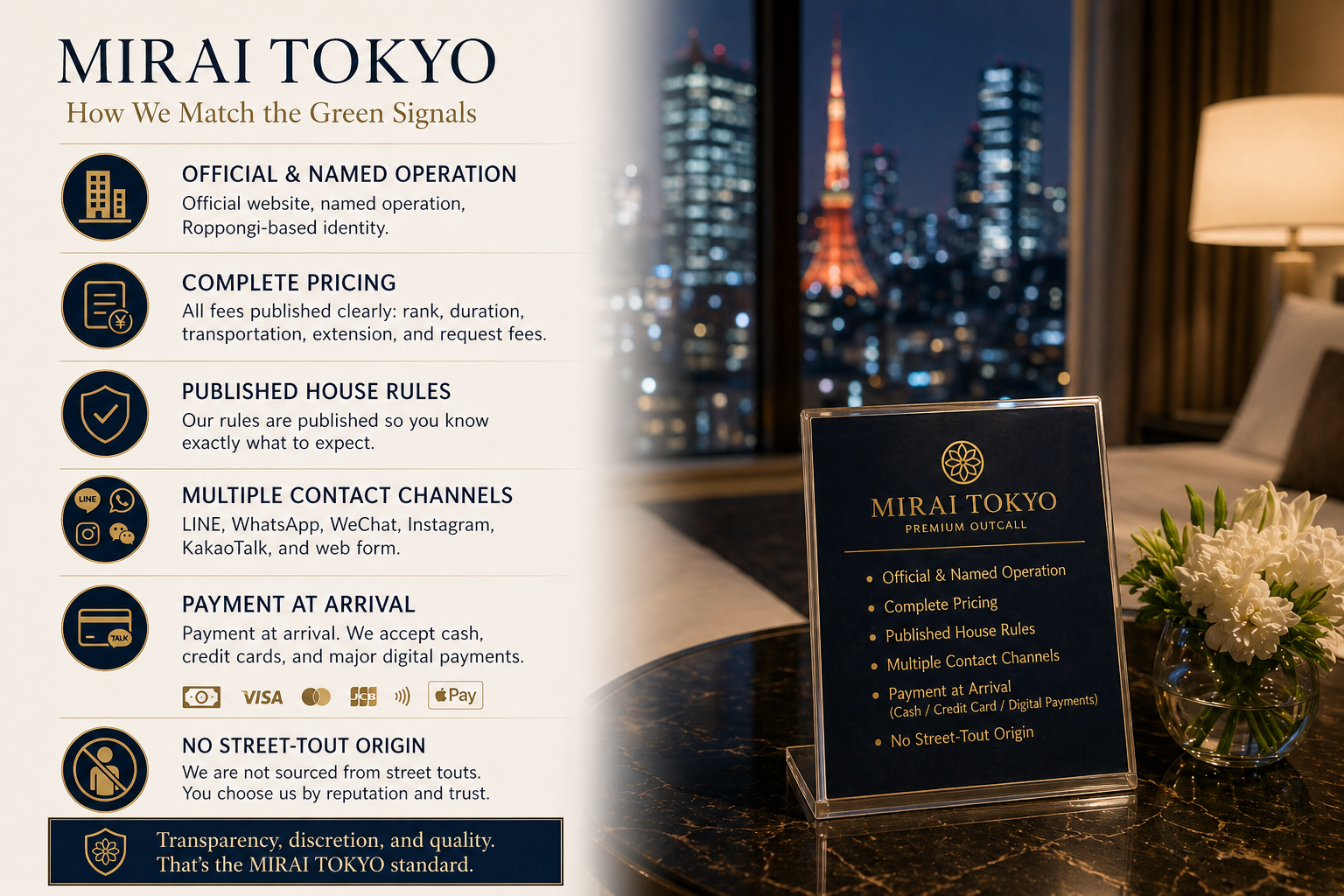
MIRAI TOKYO is a non-storefront premium outcall operator based in Roppongi. Reviewing it against the ten-item checklist:
- Official website: Yes—named operation, Roppongi-based, consistent contact information.
- Complete pricing page: Yes—Silver (¥37,000–¥85,000) through Diamond (¥70,000–¥170,000) by duration, Photo Selection ¥2,000, Repeat Request ¥5,000, 30-minute extensions ¥20,000–¥40,000 by rank, transportation free within Minato Ward and tiered ¥2,000–¥5,000 in adjacent wards.
- Business hours published: 10:00 to 6:00 (next day).
- House rules published: Yes—no minors, no full service, no photography, no drugs, no intoxication, no STIs, no violence, no multiple persons.
- Multiple official contact channels: LINE, WhatsApp, WeChat, Instagram, KakaoTalk, and web form, all English-supported.
- Hotel name in workflow: Yes—the concierge asks for hotel name/room before finalizing total.
- Payment at arrival: Yes—no advance bank transfer required.
- Cancellation policy: Same-day 100%; earlier cancellation tiers standard to Japanese market.
- No street-tout channel: Yes—booking is via inquiry through the official website or messaging apps; there are no operators steering customers from Kabukicho streets.
- Independent identity: Company name, Roppongi office, pricing and rules available before any personal information is shared.

Transparent Pricing & Rates - 3 Tiers | MIRAI TOKYO
Transparent pricing for Tokyo luxury escort service: Silver (¥37,000-¥85,000), Gold (¥45,000-¥105,000), Diamond (¥70,000-¥170,000). Time-based sessions from 60-180 minutes. No hidden fees. Free transportation within Roppongi area. English payment assistance available.
The ten-point checklist is not about MIRAI TOKYO specifically—it is a general literacy test that any legitimate premium operator should pass. MIRAI TOKYO is an example of the shape, not a unique one. But in a Tokyo English-language adult-listing market where a meaningful percentage of visible ads fail half or more of the checklist, that shape matters.
Booking Guide - 4 Easy Steps | MIRAI TOKYO
Complete guide to booking luxury escort service in Tokyo: 4-step process from inquiry to arrival. Available via phone, LINE, WeChat, WhatsApp. English support, discreet service, legal compliance explained. Learn about Japan's outcall escort culture and regulations.
FAQ
A Premium Outcall Operator That Passes All Ten Checks
MIRAI TOKYO operates in central Tokyo’s luxury hotel corridor. Published pricing page, published house rules, multiple English-supported contact channels, hotel-name-first workflow, payment at arrival. No street touts, no SNS-only funnels, no “English OK” storefront signage.
 How to Book
Last Updated: 2026-04-25
This content is for informational purposes only. It describes advertising-ecosystem patterns, publicly documented scam structures, and public safety warnings from Japanese and US authorities. It does not constitute legal advice or an authoritative list of licensed or unlicensed operators. Readers should verify current regulations and individual operator identities before engaging any service.