











 MIRAI TOKYO concierge team
Real discretion in Tokyo is created through process, not promises: limit who has access to your room details, keep communication short-lived and secure, avoid unnecessary visibility, protect your payment trail, and coordinate hotel-ready entry and exit—so your time stays private before, during, and after the booking.
Table of Contents
Introduction: Why Discretion Is the Foundation
For travelers in Tokyo who care deeply about privacy—whether you’re a business executive, a public-facing professional, or simply someone who values anonymity—discretion isn’t an optional extra. It’s the starting point.
When people search for an English-speaking escort in Tokyo, the underlying concern is often not curiosity but risk: protecting your movements, your hotel environment, and your reputation in a city that is dense, connected, and observant.
This guide explains what true discretion looks like in practical terms. Think of it as privacy by design—from the first inquiry to the final departure.
Hotel-focused discretion: Discreet Outcall in Tokyo Hotels: Privacy You Can Trust
The Anatomy of Discretion: Five Pillars of Privacy
A premium service should operate with a “minimum exposure” mindset: share less, store less, and keep every step predictable. These five areas matter most.
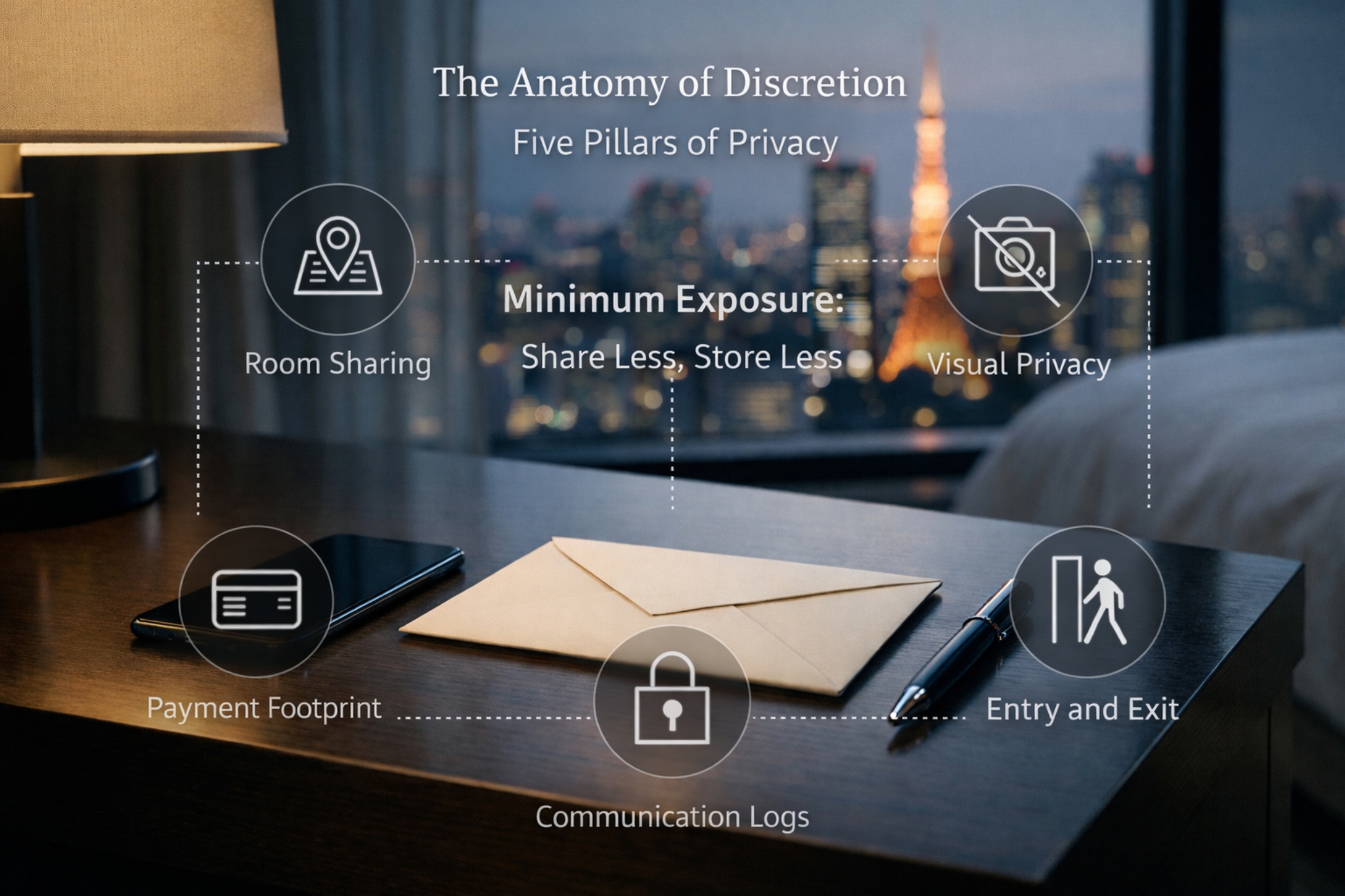
I. Room details and location sharing (who knows what, and when)
Your room number and precise location should always be treated as sensitive information.
- Professional standard: Room details are shared only when necessary for arrival and are not kept longer than required for basic administration.
- Red flag: Hotel names and room numbers passed casually through unsecured group chats or unclear dispatch systems.
II. Visual privacy (photos and recording)
Your face, your room, and your surroundings should remain private.
- Professional standard: Clear expectations that photography and recording are discouraged, supported by a culture that respects visual privacy.
- Red flag: No mention of photo or recording rules, or a relaxed attitude toward device use.
III. Payment footprint (how discreet is the transaction)
Discretion also extends to what appears on your financial records.
- Professional standard: Payments are handled discreetly, with processing methods that avoid unnecessary or revealing descriptions.
- Red flag: Payment methods that risk overly explicit statement labels or vague explanations about how charges are recorded.
IV. Communication logs (data retention)
Privacy risk often comes from what gets saved—and how long it stays there.
- Professional standard: Use of encrypted platforms (such as WhatsApp or LINE) and a clear policy to minimize retention once coordination is complete.
- Red flag: Unsolicited follow-up messages months later, suggesting your details were stored and reused without consent.
V. Entry and exit design (“invisible” hotel coordination)
In high-end hotels, discretion is as much about behavior as it is about data.
- Professional standard: Hotel-aware etiquette: calm timing, low-visibility coordination, and presentation that blends naturally into the lobby environment.
- Red flag: Arrival behavior or attire that draws attention in shared spaces.
What “Discreet” Really Means: From Claim to Protocol
At a professional level, “discreet” isn’t a slogan—it’s a repeatable system.

Staff education (privacy etiquette is trained, not assumed)
A privacy-focused service trains both staff and cast on what to avoid: unnecessary conversation, unnecessary detail, and unnecessary visibility.
Data minimization (the principle of least access)
Only the people who need specific logistical information should have access to it—and only for as long as it’s required. Less data means less exposure.
Low-friction inquiry (privacy-respecting communication)
A professional concierge can explain pricing, rules, and process clearly without invasive questions. Any sensitive requests should be limited, explained calmly, and handled discreetly.
The MIRAI TOKYO Approach: Privacy as Infrastructure
At MIRAI TOKYO, discretion is treated as infrastructure—a system designed to reduce exposure before, during, and after a booking.
Minimal retention mindset
We keep communication and logistics practical and short-lived: enough to coordinate properly, without creating unnecessary trails.
Elite-level etiquette and calm behavior
Privacy is protected through calm, hotel-appropriate coordination that feels natural within high-end environments.
Trust-first operations
For privacy-focused guests, trust is the real value. A premium service protects your reputation by making discretion the default—not something you have to ask for.
FAQ
Conclusion
In Tokyo, discretion is the ultimate luxury because it protects what matters most: your privacy, your peace of mind, and your reputation.
Don’t treat “discreet” as just a word. Treat it as a protocol—limit exposure, minimize retention, coordinate calmly, and insist on clarity—so your time stays private from beginning to end.
Start a Private Inquiry
If you’re looking for privacy-first coordination with clear English communication and hotel-aware discretion, our concierge team can guide you.

About This Guide
This guide was prepared and reviewed by a concierge team experienced in supporting international visitors in Tokyo. It outlines privacy protection principles, practical discretion protocols, and red flags that can increase exposure risk. Reference: Booking Guide – Service Process.