











 MIRAI TOKYO concierge team

“How much does deriheru cost in Tokyo?” usually has two answers: the headline-price answer (“from ¥15,000” or “from ¥20,000”) and the real-total answer, which often rises once course, nomination, transportation, extension, options, night surcharge, membership, and any hotel fees are added. This guide walks through the full nine-line fee structure, explains the common misreadings (“free” doesn’t mean no-charge), catalogs the hidden-fee patterns that inflate bills, shows practical price ranges for major Tokyo adult-service formats, and gives you a pre-booking total calculation you can verify in writing before committing.
Table of Contents
- All the Line Items on a Tokyo Deriheru Rate Card
- Why “Free” Doesn’t Mean What You Think
- Hidden Fee Patterns That Make the Final Bill Jump
- Price Ranges by Format (2024–2025 Tokyo)
- How to Calculate the Real Total Before You Confirm
- Asking for a Confirmed Total in English
- Transparent Pricing at MIRAI TOKYO
- FAQ
All the Line Items on a Tokyo Deriheru Rate Card
A complete Japanese deriheru rate structure has up to nine fee items. Licensed premium operators publish all of them. Ambiguous operators publish two or three and surface the rest after you’ve committed.
1. Course fee
The base price for the session. Varies by duration (typically 60 / 90 / 120 / 180 minutes) and by rank tier. In general Tokyo deriheru guides, 60-minute pricing is commonly presented from the mid-¥10,000 range upward, while premium hotel-based outcall at MIRAI TOKYO starts at ¥37,000 for 60 minutes in Silver and reaches ¥170,000 at the 180-minute Diamond tier.
2. Nomination fee (指名料)
Two sub-types:
- Photo selection / panel selection (写真指名 / パネル指名): Fee for choosing a companion from her profile photo. General pricing guides often place this around ¥1,000–¥2,000. MIRAI TOKYO lists Photo Selection at ¥2,000.
- Repeat request (本指名): Fee for requesting a companion you’ve met before. General guides usually place this in roughly the ¥1,500–¥3,000 range. MIRAI TOKYO lists Repeat Request at ¥5,000.
3. Transportation fee (交通費)
Tiered by distance from the operator’s dispatch area. At MIRAI TOKYO, Minato Ward is free; adjacent wards are ¥2,000–¥5,000; outside Tokyo’s 23 wards requires consultation.
4. Extension fee (延長料)
Per 30-minute increments. MIRAI TOKYO publishes 30-minute extension rates of ¥20,000–¥40,000 depending on rank. General-market guides also treat extension as a separate line item rather than something bundled into the course fee.
5. Option fees (オプション)
Additional services layered on top of the course. General deriheru may list dozens of options at ¥1,000–¥5,000 each; premium operators typically have a more contained option menu. Some “free options” are genuinely complimentary; others require scrutiny (see next section).
6. Cancellation fee (キャンセル料)
A commonly advertised pattern in Japanese pricing guides is 100% on the same day, a reduced charge the day before, and lighter or no charge when notice is given earlier. Always confirm the exact operator rule in writing before you book.
7. Membership / entry fee (会員費 / 入会金)
Some guides and regional price explainers note first-time or membership-style fees on top of the course. MIRAI TOKYO, by contrast, lists membership as free.
8. Hotel fee (ホテル代)
Applies only to hotel health (ホテヘル) in Tokyo—the customer pays the love-hotel fee separately, typically ¥5,000–¥10,000. Deriheru delivers to your hotel, so this does not apply. Premium outcall delivers to your luxury hotel—same principle, no hotel fee from the operator.
9. Night surcharge (深夜料金)
Some operators add a late-night fee after midnight. MIRAI TOKYO’s published pricing page does not list a separate night surcharge, and its published business hours run from 10:00 to 6:00 the next day.
Why “Free” Doesn’t Mean What You Think
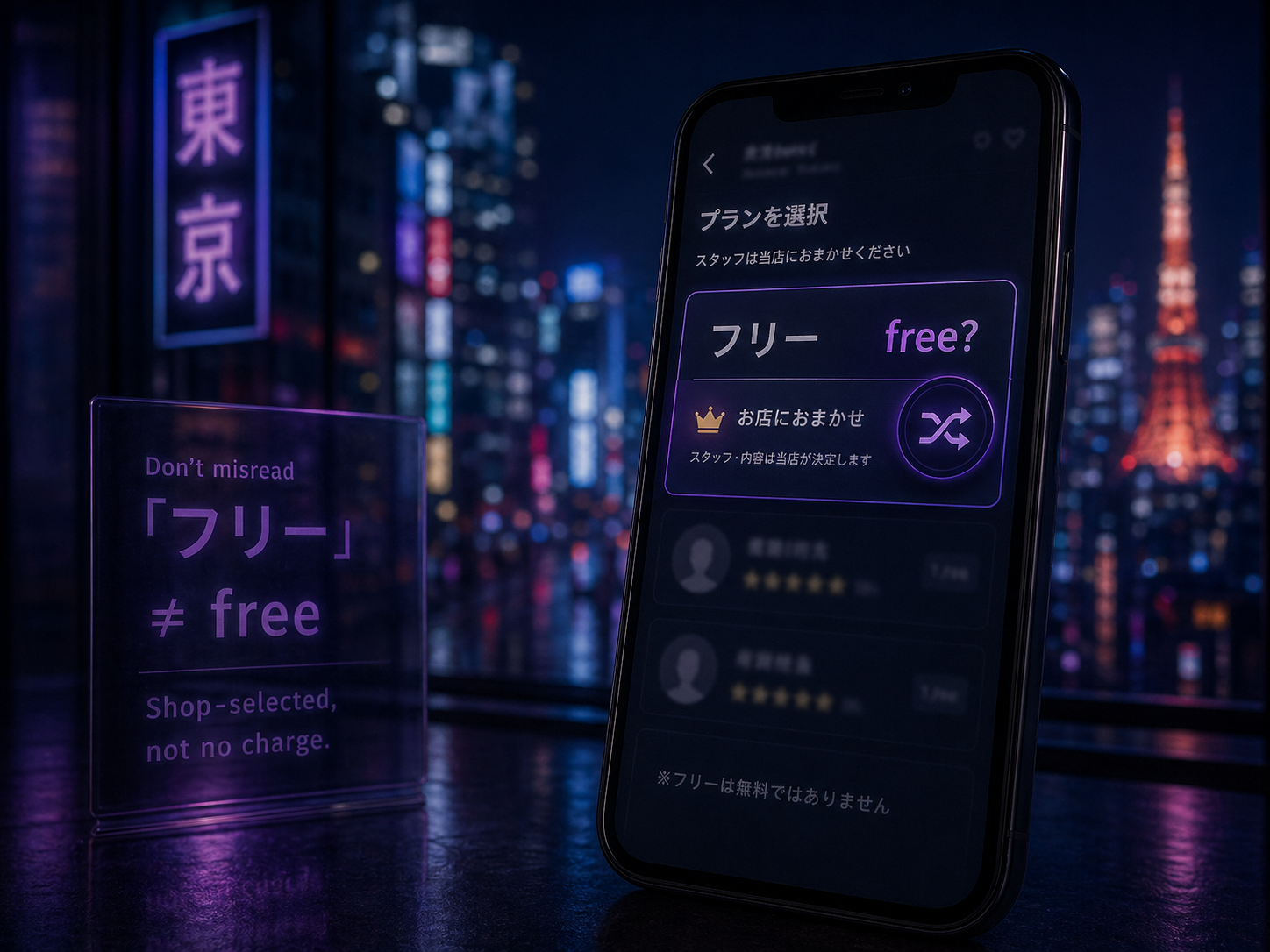
The single most common price-related misreading for English-speaking readers of Japanese deriheru listings is the word “free” / “フリー.”
“Free” / “フリー” in Japanese listings
This means the shop selects the companion for you. The customer skips the photo-browsing step and accepts whoever the shop assigns. The course fee is usually the same as for a photo-nominated booking; what disappears is the nomination fee, not the booking price itself.
“Free option” / “フリーオプション”
At legitimate operators, this means a specific option (e.g., a particular massage technique) is included at no extra cost. At ambiguous operators, the phrase is marketing noise—what is actually free and what is additional emerges later. Ask for the list in writing.
“Free designation”
A translation artifact. It usually points back to the same “フリー” idea—shop-selected companion, waived nomination fee. It does not mean the booking itself is free.
“All included / all-inclusive”
Can be legitimate (the operator has genuinely bundled everything into a single rate). Can also be the sort of claim that still leaves transportation, extension, or certain add-ons to be clarified later. The distinguishing test is simple: ask for the total in writing and compare it to the headline number.
Hidden Fee Patterns That Make the Final Bill Jump
The “from ¥XX” headline price is usually built on the lowest possible combination: the entry-rank companion, the shortest course, the closest delivery area, no nomination, no extension, and no options. What matters for a real booking is the stacked total, not the front-page minimum.
Transportation not included
Course-fee advertising often excludes transportation. Once central Tokyo delivery is added, the real total moves immediately above the headline number.
Nomination fee separate
Photo selection and repeat nomination commonly sit outside the course fee. If you want to pick who arrives, you should assume that choice has its own line item.
Options tier escalation
Option menus at some operators feature dozens of line items at ¥1,000–¥5,000 each, with suggestive descriptions encouraging multi-option orders. A few ¥3,000 options add quickly.
Extension push
Some general operators design the flow such that the session ends at an obvious moment for extension (“do you want to continue for another 30 minutes?”). Budget for the possibility even if you don’t plan to extend.
Rank-tier delivery
The “from ¥XX” price is the entry rank. If you want a specific companion at a higher rank, the course fee is that rank’s price, not the entry price. Sometimes the photo-panel layout obscures which rank is which until the booking email arrives.
Day-of membership fee
Some operators present a “first-time entry fee” of ¥1,000–¥3,000 at the point of booking. Membership itself is often genuinely free, but an initial session can attract a one-time enrollment charge.
Night surcharge
0:00 and after can attract ¥1,000–¥3,000 additional, depending on operator.
Hotel fee (if applicable)
Only applies to hotel health bookings (not deriheru or premium outcall). ¥5,000–¥10,000 for the love hotel, charged by the love hotel separately from the operator.
Realistic “from ¥18,000” → real total walkthrough
Headline course: ¥18,000. Add a photo nomination, transportation into central Tokyo, one option, and a possible extension, and the total can land dramatically higher than the advertisement. The point is not that the headline is false; it is that the headline is only one layer of the bill.
Price Ranges by Format (2024–2025 Tokyo)
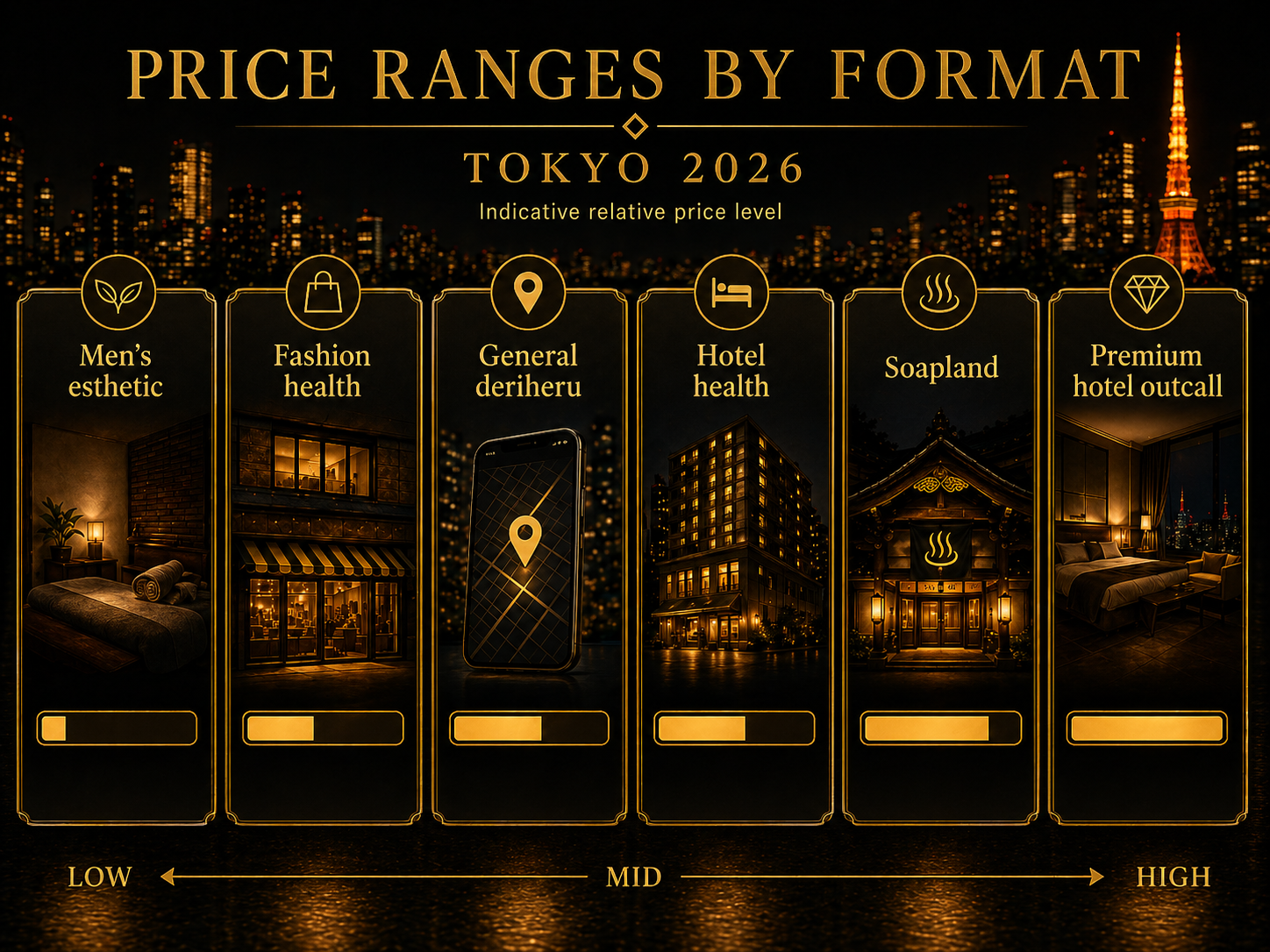
Approximate Tokyo price ranges by format, before add-ons. Some of the differences also reflect the basic split between storefront and non-storefront categories in Japan’s regulatory framework.
- Fashion health (storefront): Often presented around the mid-¥10,000 to mid-¥20,000 range for a standard session, before nomination and options.
- General deriheru (non-storefront): Tokyo-oriented guides commonly place 60-minute pricing from the mid-¥10,000 range upward, with separate nomination, transportation, and sometimes hotel or first-time fees layered on top.
- Hotel health: Often combines a course fee with a separate love-hotel bill, making the real total higher than the headline service line alone.
- Soapland: Generally sits materially above general deriheru, with higher-end Yoshiwara pricing reaching well above mainstream dispatch-level totals.
- Premium hotel-based outcall (MIRAI TOKYO segment): Published rank-based pricing runs from ¥37,000 to ¥170,000 depending on duration and tier, before optional nomination and any extension.
- Men’s esthetic: Often marketed below premium outcall pricing, with guides commonly placing 60-minute plans around the low- to mid-¥10,000 range before add-ons.
The six formats are genuinely different products. A ¥18,000 general deriheru and a ¥57,000 MIRAI TOKYO Platinum booking are not competing on price—they’re competing on entirely different feature sets (profile accuracy, language support, hotel etiquette, published rules). The ladder above is a reference, not a ranking.
How to Calculate the Real Total Before You Confirm
A three-step pre-booking calculation you can run in under two minutes:
Step 1: Anchor the course
Pick the rank × duration. If you’re considering multiple ranks (Silver vs Gold), calculate both totals and compare.
Step 2: Add the nomination
Photo selection if you’re choosing from profiles (commonly around ¥1,000–¥2,000 at general operators, ¥2,000 at MIRAI TOKYO). Repeat request if you’ve met the companion before (often around ¥1,500–¥3,000 at general operators, ¥5,000 at MIRAI TOKYO).
Step 3: Add transportation, plan for extension, check cancellation
Transportation based on your hotel’s ward. Extension at the published 30-minute rate for your chosen rank, in case you want to continue. Confirm the cancellation rule in writing before you finalize the booking.
Example walkthrough at MIRAI TOKYO: Silver × 90 minutes = ¥49,000. Photo selection: +¥2,000. Transportation (Roppongi hotel, Minato Ward): +¥0. Subtotal before extension: ¥51,000. If a 30-minute extension is chosen: +¥20,000 = ¥71,000.
Asking for a Confirmed Total in English
A short message that typically produces a complete written total on the first reply:
“Hello, I’d like to book for [date/time] for [duration] with [companion name / ‘similar profile’]. Could you send the full breakdown before I confirm? Course × rank, nomination (Photo Selection or Repeat Request), transportation, extension rate if I choose to extend, and cancellation policy. Thank you.”
A transparent operator should be able to answer this with an itemized written total. If the reply stays vague about the total until arrival, that is a reason to slow down and ask again before committing.
Transparent Pricing at MIRAI TOKYO

MIRAI TOKYO’s pricing page exposes the core fee lines covered in this guide, and its how-to page publishes the operating hours, channels, and house rules that shape the booking flow.
- Course by rank × duration: Silver ¥37,000 (60 min) through ¥85,000 (180 min); Gold ¥45,000 through ¥105,000; Platinum ¥57,000 through ¥138,000; Diamond ¥70,000 through ¥170,000; Ask rank is non-public.
- Photo Selection: ¥2,000 per companion.
- Repeat Request (本指名): ¥5,000 per companion.
- 30-minute extension: ¥20,000–¥40,000 by rank.
- Transportation: Free within Minato Ward; ¥2,000–¥5,000 for adjacent wards; outside 23 wards by consultation.
- Cancellation: Same-day cancellations due to customer circumstances are charged at 100%.
- Membership / entry fee: Free. No enrollment or annual dues.
- Hotel fee: Not applicable from MIRAI TOKYO’s side; the service is dispatched to the customer’s hotel or residence.
- Night surcharge: No separate surcharge is listed on the published price table; the published business hours are 10:00 to 6:00 the next day.
Every fee above the course line is a small percentage of the total, which is how it should be. Operators where the extras quietly double the course are not competing on the same basis.
Transparent Pricing & Rates - 3 Tiers | MIRAI TOKYO
Transparent pricing for Tokyo luxury escort service: Silver (¥37,000-¥85,000), Gold (¥45,000-¥105,000), Diamond (¥70,000-¥170,000). Time-based sessions from 60-180 minutes. No hidden fees. Free transportation within Roppongi area. English payment assistance available.
For the broader structural comparison of general deriheru vs premium hotel-based outcall, see the companion article Deriheru vs. Hotel Premium Outcall in Tokyo. For the format overview covering fashion health and hotel health, see Deriheru vs. Fashion Health vs. Hotel Health in Tokyo.
Booking Guide - 4 Easy Steps | MIRAI TOKYO
Complete guide to booking luxury escort service in Tokyo: 4-step process from inquiry to arrival. Available via phone, LINE, WeChat, WhatsApp. English support, discreet service, legal compliance explained. Learn about Japan's outcall escort culture and regulations.
FAQ
See the Full Published Price Table
MIRAI TOKYO publishes rank × duration, nomination, transportation, extension, and membership information on the official pricing page. Start with the numbers, then confirm the booking flow.
 How to Book
Last Updated: 2026-04-25
This content is for informational purposes only and does not constitute financial or legal advice. Price ranges reflect the Japanese market as of the time of writing and may change. Individual operator pricing should be verified directly with the operator before booking.